What has recently emerged in US intelligence assessments of Iran’s space capabilities goes beyond a technical report on a handful of satellites and launch vehicles. The central issue is the changing nature of space competition and the emergence of an actor that, despite having more limited resources, has managed to challenge some of the critical functions of US space-based systems in the operational environment of West Asia.
A report published on November 5, 2026, based on an assessment by the US Defense Intelligence Agency (DIA), describes Iran as an emerging space power—a designation that carries considerable significance in Washington’s security discourse. The assessment comes after the United States had previously spoken of attacks on Iran’s space infrastructure, while the commander of US Central Command (CENTCOM) claimed in March 2026 that Washington had achieved space superiority. The continued operation of Iran’s capabilities, however, has now raised questions about the absolute credibility of that claim.
US Space Superiority: A Claim Put to the Test on the Battlefield
To understand the significance of this development, it is necessary to consider the role of space in the US military architecture. Satellites are no longer merely tools for communications or imaging; they have become an integral part of military command and control, reconnaissance, positioning, weapons guidance, and coordination among military units. Disruption to any link in this chain can affect decision-making speed, operational accuracy, and coordination among forces.
Over the past several decades, Washington has established a significant advantage in this field through extensive investment in satellite constellations. Its claim to have achieved space superiority over Iran was therefore, in effect, a claim that it could use these infrastructures freely while restricting Iran’s ability to benefit from space-based capabilities.
However, the new assessment indicates that having more satellites and more advanced equipment does not necessarily guarantee complete immunity from asymmetric countermeasures. By relying on ground-based capabilities and electronic warfare, Iran can disrupt some of the functions of systems on which US forces depend. This highlights the distinction between technological superiority and operational dominance.
Todd Harrison, an aerospace expert at the American Enterprise Institute, has made a significant observation, stressing that if Iran can degrade US space capabilities, Washington cannot claim space superiority. Kari Bingen, a senior fellow at the Center for Strategic and International Studies (CSIS), has also acknowledged that, despite Iran’s more limited resources, some of its capabilities are challenging the US military’s use of space.
Electronic Warfare: The Asymmetric Point of Confrontation Between Iran and the US
One of the most important aspects of the US intelligence assessment concerns Iran’s ability to use ground-based jamming systems. These systems can interfere with the reception of satellite navigation signals, reducing positioning accuracy and affecting the performance of equipment that relies on the Global Positioning System (GPS).
The significance of this capability becomes clearer when we consider that a substantial portion of modern military equipment depends on satellite data for positioning, operational coordination, and the guidance of certain weapons. Disrupting navigation signals can therefore increase the cost of using advanced technologies, even without destroying satellites or directly attacking orbital infrastructure.
The important point is that this type of countermeasure does not necessarily require a satellite fleet comparable to that of the United States. In asymmetric warfare, the objective may be to disrupt part of a superior system’s operational chain rather than compete with every component of that system. From this perspective, Iran’s ground-based capabilities, alongside other defensive tools, can increase the operational costs facing US forces.
The report also refers to a September 2026 warning by the US Department of Transportation about significant disruptions to global navigation satellite systems in the Strait of Hormuz area. This indicates that navigation interference is not merely a theoretical issue confined to the military domain; it can also have maritime and commercial implications. However, the existence of such interference does not, by itself, establish the source or identify the responsible party in every recorded incident.
Twelve Satellites Against Thousands: The Difference Between Numbers and Capabilities
One of the notable figures in the published assessment is the comparison between Iran’s and the United States’ satellite capabilities. According to information from the American Enterprise Institute cited in the report, Iran has approximately 12 operational satellites, while the US satellite fleet is reported to be more than a thousand times larger.
This gap reflects the considerable difference in the scale of the two countries’ space infrastructure and cannot be overlooked. The United States continues to enjoy a substantial advantage in satellite numbers, investment, reconnaissance capabilities, and the scale of its orbital networks. Nevertheless, the strategic significance of the issue lies in Iran’s ability to develop tools that can disrupt some of these networks’ functions despite its more limited resources.
In reality, the main issue is not the number of satellites but the ability to make effective use of existing capabilities and prevent the other side from exploiting its own infrastructure without restrictions. It is this distinction that gives Iran’s asymmetric capabilities their strategic significance.
From Soraya and Chamran to Khayyam and Future Satellite Constellations
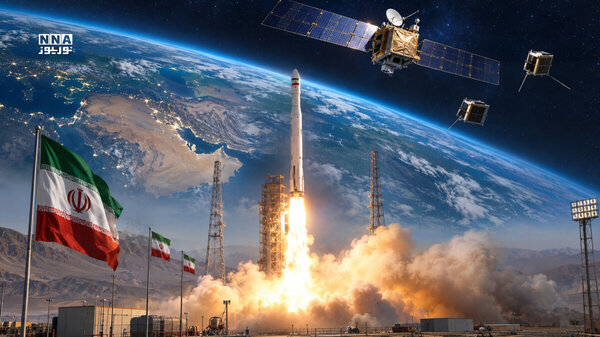
The trajectory of Iran’s space development also indicates that the country’s program is no longer limited to experimental launches. It is pursuing a range of applications in telecommunications, research, remote sensing, and imaging.
The Soraya satellite, weighing approximately 50 kilograms, was placed into a 750-kilometer orbit in January 2024 using the Qaem-100 launch vehicle. The launch was significant because it marked Iran’s achievement of a new orbital altitude. Subsequently, the Chamran-1 satellite, weighing approximately 60 kilograms, was placed into a 550-kilometer orbit in September 2024. Its primary mission was to test hardware subsystems, cold-gas propulsion, and orbital maneuvering capabilities.
In the field of imaging, the Khayyam satellite, launched in August 2022 aboard a Soyuz launch vehicle from the Baikonur Cosmodrome, is capable of imaging at a resolution of approximately one meter. This capability is important for monitoring water resources, agriculture, land management, and environmental changes.
Alongside these achievements, the Pars, Nahid, Kowsar, and Hodhod satellite families constitute other components of Iran’s space development program. Pars-1 has been placed in orbit, while Pars-2 and Pars-3 are under development. Pars-2 is designed to achieve an imaging resolution of less than three meters, while Pars-3 aims for one-meter resolution. In the telecommunications sector, Nahid-2 has been placed in orbit, while Nahid-3 remains under development.
In the field of radar satellites, the Radar-1 project is also being pursued using synthetic aperture radar (SAR) imaging technology. The main advantage of this technology is its ability to capture images regardless of lighting conditions and overcome limitations caused by cloud cover. This capability can be used for Earth observation, disaster management, and detecting changes on the Earth's surface.
Taken together, these projects demonstrate that Iran’s space program is seeking to diversify its satellite missions. If fully developed and operationalized, this diversification could reduce the country’s dependence on foreign data and services.
Indigenous Satellite Launch Vehicles: The Decisive Link in Space Independence
Developing satellites without having an independent launch capability cannot lead to strategic independence. From this perspective, the Qaem family of launch vehicles represents one of the most important components of Iran’s space program.
The Qaem-100, the operational member of this family, is a three-stage, all-solid-fuel launch vehicle capable of carrying an 80-kilogram payload to a 500-kilometer orbit and a 60-kilogram payload to a 750-kilometer orbit. The successful launches of Soraya and Chamran-1 are among its recorded missions.
The Qaem-105 is the next model in the series. It is a four-stage launch vehicle measuring 23.5 meters in length and weighing 18 tons, designed to carry payloads of up to 200 kilograms to a 500-kilometer orbit. The system has been introduced as being in the development and suborbital testing phase.
The Qaem-110, powered by solid-fuel propulsion and designed to carry heavier payloads to medium orbits, remains in the research and development stage. The Qaem-120, meanwhile, is a long-term project aimed at developing the capability to place payloads into geostationary orbit at an altitude of approximately 36,000 kilometers.
Alongside this family, the development of the Simorgh launch vehicle and the Phoenix project is also underway. Phoenix has been proposed as a system designed to carry heavy payloads and orbital transfer stages. This diversity in launch vehicle design and development is strategically significant because satellite production becomes a sustainable advantage only when a country can independently place its satellites into orbit.
The Shahid Soleimani Constellation and Chabahar Spaceport: Two Paths for Future Development
Another major project in Iran’s space program is the Shahid Soleimani satellite constellation. The project is designed to establish a network of 24 satellites in low Earth orbit, consisting of 16 primary satellites and eight backup satellites.
The constellation’s main function is to provide narrowband communications services based on the Internet of Things (IoT). Such a network could be used for the remote monitoring of critical infrastructure, energy transmission lines, environmental protection, smart agriculture, and communications in remote areas.
An important advantage of this technology is that it reduces dependence on ground-based communications infrastructure, which may be vulnerable to damage during a crisis. However, realizing the full potential of this capability depends on completing, launching, and operationally deploying the entire satellite constellation. A project still under development should not be equated with a fully operational network.
Alongside this project, the Chabahar Spaceport is also of strategic importance. Its geographical location on the Makran coast, adjacent to the Indian Ocean, provides opportunities to explore various launch trajectories, particularly for polar and sun-synchronous orbits.
The spaceport’s development program has been defined in three phases. The first phase is designed for solid-fuel launch vehicles and the Qaem family. The second will accommodate heavy and medium-lift liquid-fuel launch vehicles, such as Simorgh and Phoenix. The third phase aims to establish commercial launch capabilities and provide access to higher orbits.
According to information published about the project, more than 60 percent of the first phase had been completed by 2024. The other two phases are being pursued as part of longer-term development plans. Completion of this infrastructure could increase Iran’s independence in accessing space while also creating opportunities to provide launch services to other countries.
Why Does the New US Assessment Have Strategic Significance?
The significance of the latest US intelligence assessment can be examined at three levels.
First, it demonstrates that attacks on a country’s physical infrastructure do not necessarily mean the destruction of its scientific and technological capabilities. A space program depends on a broad network of specialized knowledge, skilled personnel, research centers, knowledge-based companies, supply chains, and design and manufacturing capabilities. Destroying a single facility, therefore, cannot eliminate all of these capabilities.
Second, space competition is no longer limited to the number of satellites or the power of launch vehicles. The ability to disrupt navigation systems, protect equipment against electronic warfare, use remote-sensing data, and maintain communications under wartime conditions has become an important part of the new equation of power.
Third, the expanding civilian and economic applications of space technology have extended its importance beyond the defense sector. Communications, agriculture, water resource management, transportation, environmental monitoring, and disaster management are all becoming increasingly dependent on satellite services. Investment in this field is therefore both a development necessity and a component of national security.
A realistic assessment, however, requires maintaining a clear distinction between existing capabilities, projects under development, and long-term objectives. The United States continues to enjoy a substantial advantage in satellite numbers and the scale of its space infrastructure, and the intelligence report does not deny this gap. What has changed is that exploiting this superiority without restrictions in the operational environment of West Asia has become more difficult.
Ultimately, the central message of Washington’s latest assessment can be summed up in one reality: technological superiority does not necessarily translate into operational invulnerability. By developing indigenous capabilities, diversifying satellite missions, expanding launch capacity, and employing asymmetric tools, Iran has demonstrated that space competition cannot be measured simply by counting the satellites operated by the two countries.
What is now challenging US military calculations is not parity between Iran and the United States in terms of space infrastructure, but the emergence of capabilities that can increase the costs of Washington’s pursuit of superiority. From this perspective, the US claim to space superiority faces a fundamental question: If a country’s space power cannot guarantee that it will be able to use its capabilities without restrictions from its adversary, how credible is that superiority in the real operational environment?