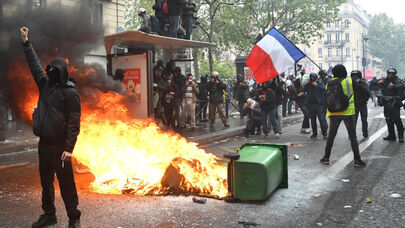
The US-Israeli war and the consequences of the situation in the Strait of Hormuz, coupled with rising economic costs, have intensified a wave of public protests across European countries. French President Emmanuel Macron and German Chancellor Friedrich Merz have also acknowledged the war’s repercussions. Meanwhile, revelations about the growing extent of Europe’s involvement in US crimes against Iranians have further underscored Iran’s legal, political and security-based grounds for holding European countries accountable. They also lend greater weight to Iran’s position that the geographical scope of accountability for hostile actions must be expanded — and no longer remain confined to the United States and the Israeli regime.
US withdrawal from Europe: Political retaliation or forced retreat?
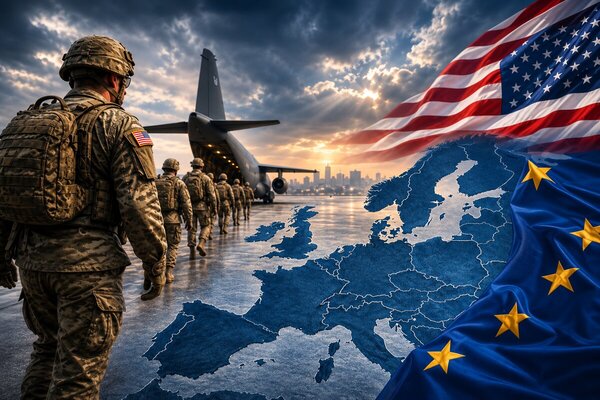
As the US midterm congressional elections approach, reports indicate that NATO diplomats are concerned about Donald Trump’s increasing pressure on the alliance and the possibility of thousands of US troops being withdrawn from Europe. On the surface, the move is being portrayed as Trump’s retaliation against European countries for refusing to support his policies. The reality, however, goes beyond this narrative.
On the one hand, the potential withdrawal of US forces stems from Washington’s failure to honor its commitments to its allies. During the Ramadan War, for instance, the United States effectively made Arab countries the first casualties of its pursuit of Israeli interests. In recent weeks, it has also set aside its commitments to Ukraine in exchange for a few barrels of Russian diesel. On the other hand, the US defeat in the Ramadan War, the costs of which have been estimated at $47 billion by the Pentagon and more than $100 billion by intelligence and operational circles, together with the depletion of its weapons stockpiles, has severely constrained the country's military capacity to sustain its global military presence.
Therefore, a US withdrawal from Europe is less a show of strength or an act of retaliation than a clear indication of Washington’s weakness and inability to maintain its global military posture. Washington is seeking to justify part of the scale of this weakness through a Hollywood-style narrative surrounding RAF Fairford.
NATO admissions: Evidence of Europe’s involvement in the war against Iran
European countries continue to speak of diplomacy and insist that Iran should compromise on its inalienable rights, even as new details emerge every day about their involvement in US and Israeli crimes during the Ramadan War. NATO Secretary General Mark Rutte has stated on several occasions that European countries supported attacks against Iran by providing 5,000 sorties and making their bases and logistical facilities available to the United States.
In this context, John R. Deni, a research professor at the US Army War College and a nonresident senior fellow at the Atlantic Council and NATO Defense College, acknowledges the importance of European bases in the bombing operations against Iran in an article published on the Breaking Defense website. Examining the implications of a US troop withdrawal from Europe, Deni notes that a round-trip bombing mission from US territory to Iran takes approximately 36 hours, whereas the same mission from the United Kingdom takes around 15 hours.
He also writes that, by early April, the United States had conducted 62 bombing missions against Iran, of which only 18 had originated in North America, while the remainder had been launched from European bases. Access to these bases also saved US taxpayers approximately $75 million during the first five weeks of the war.
These admissions leave little room for doubt about Europe's operational role. Diplomatic rhetoric and demands that Iran make concessions — even measures such as placing the Islamic Revolutionary Guard Corps (IRGC) on a so-called terrorist list — cannot conceal Europe's involvement in the war against Iran. Russia's representative to international organizations has also repeatedly cited documents and evidence to highlight Europe's support for and encouragement of the military aggression against Iran.
Europe: From complicity in aggression to liability for reparations
These admissions bring to light facts that European countries can no longer deny. From the perspective of international law and the right to self-defense, Iran has the right to demand accountability, seek punitive measures and claim damages and reparations from countries involved in the war. From a security and military standpoint, the consequences of this involvement cannot be separated from the responsibility of European governments. Restrictions on maritime traffic and on the passage of European oil tankers and container ships through the Strait of Hormuz represent only part of the leverage available in response to such conduct.
Europe cannot use the United States and the Israeli regime to carry out its warmongering policies and dirty work while simultaneously hiding behind the mask of diplomacy to demand that Iran relinquish its rights. Macron, Merz, UK Prime Minister Burnham and other European leaders should have considered the consequences before aligning themselves with the war against Iran.
They cannot now shift the blame for Europe's economic crisis and social protests onto Iran, reversing the roles of the accused and the aggrieved party. The time has come to hold those involved accountable for crimes against humanity and for fomenting war against Iran.
The end of geographical limits on Iran’s response
Iran remains committed to diplomacy, but the fulfillment of its seven conditions is a prerequisite for any negotiations. Otherwise, there will be no negotiations, and the Strait of Hormuz will remain closed. Moreover, any new military adventurism against Iran will be met with new capacity-building measures, in line with the Leader of the Islamic Revolution’s remarks during a meeting with military commanders. These measures include allowing Iran to determine the course of the war, expanding its scope without geographical limitations, establishing a new target bank encompassing all US material and non-material interests, and taking coordinated action across the entire Axis of Resistance.
The fundamental point is that the geographical scope of Iran’s response now extends to Europe as well, particularly given that documents and evidence point to the direct and comprehensive role played by European countries in the US-Israeli war against Iran.
Iran had limited the range of its missiles and drones not because of technical constraints, but on the basis of its commitment to restraint and the geographical scope of the threats it faced. The same approach has guided its nuclear policy, under which it has refrained from pursuing the development of a nuclear bomb. As the late Admiral Ali Shamkhani previously emphasized, the range of Iran’s missiles would increase in proportion to the level of threats against the country.
Now that the scope of the threat has expanded beyond the region and reached Europe, a corresponding adjustment in Iran’s defensive capabilities and response range would also become a necessity. Europe must understand that direct or indirect involvement in a war against Iran carries serious responsibilities and far-reaching consequences.