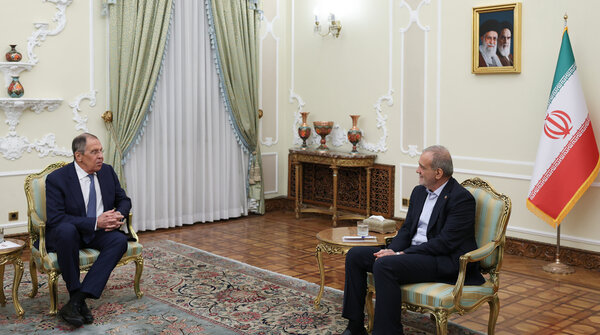
Pezeshkian made the remark in a Monday meeting with Russian Foreign Minister Sergei Lavrov, who is in Tehran at the head of a diplomatic delegation for leading talks about the latest regional and international developments.
“We believe that the presence of US military bases in regional countries has brought, and will continue to bring, no benefit to the region, serving only to increase tensions, escalate divisions, and fuel instability and insecurity,” he said.
He added that the martyrdom of the Leader of the Islamic Revolution, military commanders, scientists and schoolchildren, as well as attacks on the country’s infrastructure during the recent US-Israeli aggression against Iran, violated international law and norms.
He emphasized that the attacks took place while Iran was pursuing dialogue and diplomatic engagement.
“The Islamic Republic of Iran does not accept any country imposing its will and demands on other nations by relying on its power and means of pressure. We seek a world based on mutual respect, observance of the nations’ rights, constructive cooperation, and multilateralism,” Pezeshkian said, noting that Iran and Russia shared similar views on such principles.
The United States and Israel jointly began an unprovoked aggression on Iran on February 28 by targeting Iran’s top officials and civilian infrastructure, including roads, bridges, and railway lines.
In response, the Iranian armed forces launched powerful retaliatory attacks against US and Israeli assets in the region, dealing heavy blows to the invading coalition.
The war came to a halt after 40 days with a ceasefire, which was then formalized in mid-June by signing the Islamabad Memorandum of Understanding by the presidents of Iran and the US.
Elsewhere in his remarks, Pezeshkian pointed to Iran’s historical, cultural and religious bonds with regional countries and underscored the need to strengthen “neighborhood diplomacy” and expand constructive engagement among Muslim countries.
“Iran had no fundamental disagreements with regional states and is ready to resolve existing issues and challenges through dialogue, understanding and regional mechanisms,” the Iranian president said.
He also called for accelerating the implementation of agreements between Tehran and Moscow, noting that bilateral cooperation in energy, transport, trade and power generation is among priorities of bilateral cooperation.
“Iran and Russia can play an effective role in promoting peace, sustainable security, and a multilateral world order by relying on their shared capacities and making use of regional and international mechanisms,” he pointed out.
Pezeshkian also thanked the Russian president, government and people for their support during the recent US-Israeli war, placing a premium on continued mutual support and stronger political and diplomatic cooperation in line with the common interests of Tehran and Moscow.
The Iranian president said Tehran welcomes any joint initiative and mechanism with regional countries on peace and security, economic development, cultural and scientific cooperation, and people-to-people ties.
Iran believes that sustainable security in the region should rest on mutual trust, participation of regional countries and respect for the legitimate interests of all sides, Pezeshkian said.
For his part, Lavrov reaffirmed Moscow’s determination to strengthen cooperation with Tehran, saying the two countries can enhance interaction in oil and gas, communications and media, cultural exchanges, transport, energy, scientific cooperation and university sectors.
The Russian foreign minister also noted that Iran and Russia shared views on international issues and emphasized the importance of continued diplomatic consultations and utilization of the existing capacities to help promote peace and security.
Earlier in the day, Lavrov held talks with Iranian Foreign Minister Abbas Araghchi and attended a joint press conference with him.
During the news briefing, Araghchi highlighted the “close” cooperation and consultations between Tehran and Moscow, saying both sides believe regional issues cannot be resolved militarily and should instead be addressed through diplomatic and political channels.