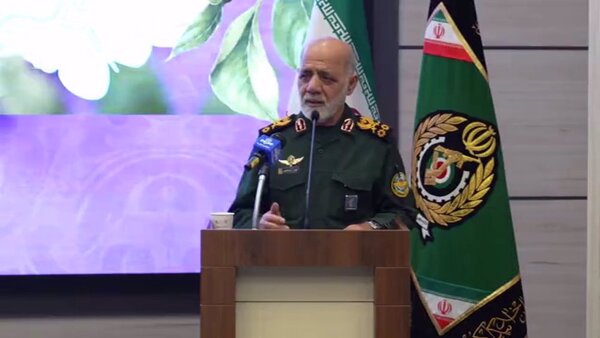
Chief of the General Staff of Iran’s Armed Forces, Major General Ali Abdollahi, made the remarks during a ceremony honoring martyred Defense Minister Aziz Nasirzadeh and introducing his successor, Mehrdad Akhlaghi.
"We will defend our country under any circumstances. We will not allow any aggressor to encroach upon the country whether it seeks to seize our territory or harm the Islamic Republic establishment,” Abdollahi said.
He also highlighted the failure of the administration of US President Donald Trump to bring Iran to its knees due to enhanced unity among the Iranian people and their officials.
“The US is no longer the superpower it once claimed to be. It has grown old,” he added. “Trump tried everything he could, but he failed because Iran’s government and nation stand united.”
The commander referred to Iran’s national unity, public resilience, coordination among different branches of the government, and the efforts of the Armed Forces as key factors in helping the country overcome difficult circumstances.
He further said that the Islamic Republic has never started a war and has always defended the country and its people against acts of aggression.
The United States and the Israeli regime waged their first illegal war against Iran, which lasted 12 days, in June 2025. Their second aggression began on February 28, 2026, and came to a halt in early April after 40 days.
In both wars, Iran’s resistance and successful retaliatory operations forced the aggressors to accept a ceasefire.
Iran has also maintained a tight grip on the Strait of Hormuz since the early days of the second imposed war amid the US’s acts of mischief in the region.
Additionally, in his remarks, Abdollahi said the recent wars have underscored the need to rethink Iran’s approaches to preparedness and response to emerging threats.
He also noted that future wars will not be confined to a single domain and will involve hybrid, technological, intelligence, and cognitive dimensions.
“Defensive capabilities must be enhanced based on a thorough understanding of threats and in line with the evolving nature of future warfare,” he said.
“Serious efforts must be made to advance technology and improve the precision and effectiveness of equipment in key areas, including missiles, drones, air defense, naval systems, electronics, and communications.”
The commander called for the effective use of the latest technologies, artificial intelligence, and advanced scientific knowledge in the Armed Forces.