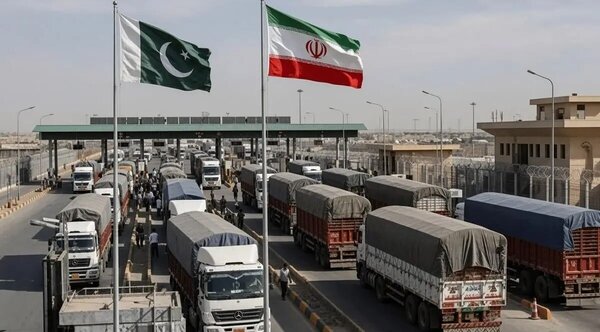
Nournews: According to media reports, around 3,000 trucks have been stranded along the Iran–Pakistan border in recent days, unable to enter the neighboring country. But the issue goes beyond a long line of trucks. With the US naval blockade putting much of Iran’s trade routes under pressure and Tehran turning to land borders to maintain the flow of imports and exports, the suspension of trade at two key crossings with Pakistan raises a pressing question: Is pressure to close Iran’s land routes beginning to take shape, and is Pakistan the first link in that chain?
Initial reports from the border were contradictory. A notice circulated on social media announcing a temporary suspension of cross-border traffic and trade between Iran and Pakistan, but doubts were subsequently raised about its authenticity. In the following days, however, multiple sources confirmed that commercial activity had been halted at the Rimdan crossing and that trade had been suspended at the Gabd–Rimdan and Taftan crossings. Pakistani officials have cited security concerns, anti-smuggling measures and efforts to improve border management as reasons for the move, while Iranian officials have referred to “technical problems” and the adoption of precautionary measures. Based on the available reliable and largely official reports, the most that can currently be said is that land trade between the two countries has been temporarily halted or seriously disrupted. The move has not been officially declared part of an overt operation to impose a land blockade on Iran.
The significance of the situation lies precisely in the gap between what is happening on the ground and the political reasons behind it. As the US imposed what Tehran regards as an unjust naval blockade, land borders became vital lifelines. The US naval blockade in recent months has forced Iran to pursue alternative trade routes more aggressively. In Tir (June–July), the United States reinstated its blockade of Iranian ports and vessels linked to Iran, placing severe constraints on the country’s main maritime trade routes.
Under these circumstances, some of the pressure on trade was bound to shift to land borders. Iran shares land borders with seven countries, a geographical advantage that distinguishes it from countries that can be almost entirely cut off from global trade through a naval blockade. In recent months, Tehran has sought to make greater use of routes through Turkey, Pakistan, Afghanistan, Iraq, Turkmenistan and its northern neighbors. In Ordibehesht (April–May), Iran’s economy minister spoke of activating land borders and northern ports to maintain trade flows.
Pakistan occupies a distinct position in this equation. It shares a border with southeastern Iran, has major ports such as Karachi and Gwadar, and can serve as a land transit route for goods destined for Iran. For months, efforts had been underway to ease some of the bottlenecks created by disruptions to maritime trade through Pakistan. In Farvardin (March–April), Pakistan even activated six transit routes for goods bound for Iran. Before that, thousands of containers carrying Iranian-bound goods had been stranded at Pakistani ports. When this alternative route itself becomes subject to suspension or disruption, the issue is no longer merely a border-administration dispute. Any bottleneck along an alternative trade route takes on strategic significance.
Is Pakistan Enforcing US Sanctions?
Two distinct accounts need to be considered.
The first is Pakistan’s official explanation: the suspension of trade is a temporary measure prompted by security concerns, anti-smuggling efforts and the need to improve border management. Officials in Pakistan’s Balochistan province have said that negotiations with Iran to resolve the problem are ongoing and that the crossings are expected to reopen once the outstanding issues have been addressed.
The second explanation concerns banking difficulties. Iranian business representatives have said that new requirements for registering and verifying import and export transactions within Pakistan’s banking system, combined with sanctions on Iran’s banking sector, have made trade increasingly difficult for Pakistani importers and Iranian exporters. According to this account, even if the border remains physically open, the financial system behind it may be effectively blocked. Published reports have also stressed that the current disruption does not necessarily mean the border has been completely closed, with some of the difficulties stemming from payment procedures and banking requirements.
This distinction matters considerably. A land blockade does not necessarily begin with barbed wire and trucks being turned away. Its first stage could instead involve tighter banking, insurance, transportation, transit and customs requirements, making trade practically impossible even when it is not formally prohibited under the law.
From this perspective, developments in Pakistan warrant close scrutiny. Only a few weeks ago, reports emerged that the United States was considering additional options to intensify economic pressure on Iran, with a “land blockade” among the options reportedly under consideration. Implementing such a measure, however, would be extremely difficult without the cooperation of Iran’s neighboring countries.
This does not mean that the latest move by Pakistan can be attributed to the United States. There is currently insufficient evidence to support such a claim. Nevertheless, the timing of the disruption—amid maritime pressure and Iran’s efforts to shift trade to land routes, with one of its most important alternative corridors now affected—deserves strategic attention and careful monitoring.
A Complete Blockade Would Be Difficult, but Bottlenecks Can Be Created
Iran’s geography makes a comprehensive land blockade extremely difficult to implement. Iran borders Turkmenistan to the northeast, Azerbaijan and Armenia to the northwest, Turkey and Iraq to the west, and Afghanistan and Pakistan to the east. Through the Caspian Sea to the north, it is also connected to a network of regional trade routes. None of these countries is necessarily willing to bear the economic and political costs of completely severing trade with Iran.
Developments in recent months bear this out. Even under a naval blockade, Iran’s trade has not come to a complete halt, with some of it redirected through land routes. The Financial Times has reported a sharp increase in Iran’s overland trade with Turkey, while other reports have described the activation of land routes through Pakistan and other neighboring countries.
But this does not mean land-based pressure would be ineffective. A complete blockade may be difficult to achieve, but creating multiple bottlenecks is entirely possible.
One route could face security restrictions, another tighter customs requirements. One could encounter banking and payment difficulties, while another could be affected by insurance and transportation restrictions. The cumulative effect could resemble a blockade without any country formally declaring that it has closed its border with Iran.
The long queues of trucks at Rimdan are significant precisely in this context. Reports indicate that trucks have been held up along this route for weeks. Limited infrastructure capacity, the involvement of multiple agencies, customs requirements and the need to transfer cargo between trucks on either side of the border have also increased transportation times and costs.
The central question, therefore, is no longer simply whether Pakistan has closed its border. The more important question is whether Iran’s alternative trade routes are gradually becoming bottlenecks, one after another.
If the current disruption in Pakistan proves short-lived and is resolved through talks between Tehran and Islamabad, it can be viewed within the framework of border security, technical problems and administrative difficulties. But if banking and trade restrictions persist, if routes through Turkey and Pakistan face mounting delays simultaneously, and if neighboring countries come under pressure from secondary sanctions that raise the cost of doing business with Iran, a different picture could emerge: pressure would have shifted from the sea to Iran’s overland trade network.
Under such circumstances, a policy of strengthening ties with neighboring countries would no longer be merely a desirable foreign policy objective; it would become a key component of the country’s economic resilience. A neighbor that serves as a trade corridor today could become a trade bottleneck tomorrow.
For this reason, Tehran must not only work urgently to restore trade through Pakistan but also activate several alternative routes simultaneously and avoid excessive dependence on any single corridor.