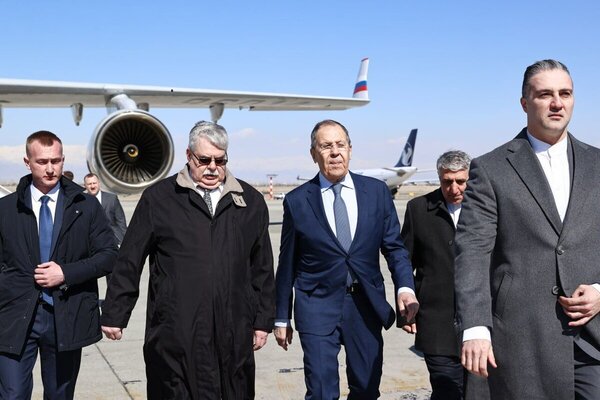
The visit by Russian Foreign Minister Sergei Lavrov to Tehran, where he met with President Masoud Pezeshkian and Foreign Minister Seyed Abbas Araghchi, assumes significance in the context of the two countries’ strategic ties and regional and global developments. Reducing the visit to Moscow’s efforts to mediate between Tehran and Washington—particularly following an agreement between Putin and Trump on the transfer of Russian diesel fuel to the United States—would be a misreading of the broader relationship between the two neighboring countries. Their ties are grounded in a 20-year strategic agreement and shared political, economic, and security objectives.
Strategic Convergence: Beyond Diplomatic Meetings
Drawing on their historical ties, shared strategic interests, and the imperatives arising from developments in the international system, Iran and Russia are pursuing comprehensive expansion of their bilateral and multilateral relations. Although some interested parties seek to weaken ties between Tehran and Moscow by driving regional countries apart, regional and global realities have made closer cooperation between the two countries increasingly necessary. Regular meetings between officials at various levels, along with presidential consultations at BRICS, Shanghai Cooperation Organization (SCO), and Commonwealth of Independent States (CIS) gatherings, reflect this trend.
The meeting between Lavrov and Araghchi will mark the foreign ministers’ fourth in-person meeting this calendar year. In addition, the two sides have held 14 phone conversations to date. This sustained diplomatic engagement should be seen as part of their shared determination to advance long-term objectives, including expanding trade in national currencies, Russian investment in Iran’s energy sector, and expediting completion of the Rasht–Astara railway. Achieving these priorities would not only strengthen the two countries’ economic interests but also enhance their transit capacity and regional standing.
Regional Security: Common Ground Between Tehran and Moscow
A key pillar of convergence between Iran and Russia is their emphasis on regional security based on cooperation among neighboring countries and their opposition to foreign interference. The 3+3 initiative in the Caucasus, opposition to Armenia and Azerbaijan becoming entangled in Western corridors and projects that could fuel instability, calls for keeping the Caspian Sea demilitarized, and Moscow’s consultations on Afghanistan are examples of this shared approach. Annual military exercises provide a complementary dimension to their security cooperation.
In West Asia, Iran has also stressed the need to establish a regional security framework through its Hormuz Peace Initiative and efforts to strengthen cooperation among neighboring countries bordering the Persian Gulf and the Sea of Oman. Iran’s peace initiatives to end the war between Saudi Arabia and Yemen, including those raised at the recent Organization of Islamic Cooperation (OIC) meeting, fall within the same framework. The failure of some initiatives, partly because certain Arab countries lack independent decision-making authority, does not diminish the strategic importance of this approach. Management of the Strait of Hormuz, opposition to the Israeli regime, and calls for an end to the US military presence in the region can likewise be understood as extensions of this outlook.
Russia, for its part, has emphasized regional security by supporting joint initiatives among countries bordering the Persian Gulf and the Sea of Oman and opposing provocative conduct stemming from interference by powers outside the region. Its condemnation of escalating tensions by the United States and the Israeli regime, support for a political solution in Yemen, and condemnation of the Israeli regime’s occupation and crimes in Palestine and across the region—including its military aggression against Iran—demonstrate that Tehran and Moscow share the view that externally driven crises must be resisted.
Diplomacy and the Battlefield: Two Pillars of Deterrence
Following a phone conversation between Putin and Trump and an agreement on the transfer of Russian diesel fuel to the United States, speculation has emerged about Moscow mediating between Tehran and Washington. However, proposals such as transferring Iran’s enriched uranium to Russia, subject to Tehran’s consent, have been raised before and are not new. More importantly, interpreting these developments as mediation cannot explain the broader nature of the two countries’ strategic relationship.
Iran and Russia view diplomacy and on-the-ground capabilities not as competing paths but as complementary instruments for safeguarding national interests and countering US pressure. While emphasizing negotiations with Washington, Russia has maintained its military readiness in the face of Western threats, including in the Ukraine conflict.
With regard to Iran, Russia’s support for a political solution, its vetoes of anti-Iranian resolutions at the UN Security Council, its opposition to measures targeting Tehran at the IAEA Board of Governors, and its emphasis on Iran’s right to respond militarily to aggression by the United States and the Israeli regime all reflect this approach. Moscow has also supported Iran’s positions in forums such as BRICS, the SCO, the United Nations, and the Security Council.
A Multilateral World Order: A Shared Vision for Cooperation
Iran, too, has sought to use diplomacy to manage crises while maintaining its defensive capabilities and deterrence. The Islamabad agreement and the efforts of Oman, Qatar, and Pakistan can be viewed within this framework. Under this approach, negotiations do not replace defensive power; rather, they serve as a means of safeguarding national security and interests.
Against this backdrop, Lavrov’s visit to Tehran is part of a joint effort to reinforce the synergy between diplomacy and on-the-ground capabilities, strengthen deterrence, and expand economic and security cooperation. Coordination at the United Nations, BRICS, the SCO, and the Eurasian Economic Union also forms part of this broader trajectory.
As two independent actors, Iran and Russia have the capacity to play an influential role in shaping a multilateral world order and countering Western unilateralism. Realizing this potential, however, requires sustained high-level consultations and the translation of strategic agreements into practical cooperation.