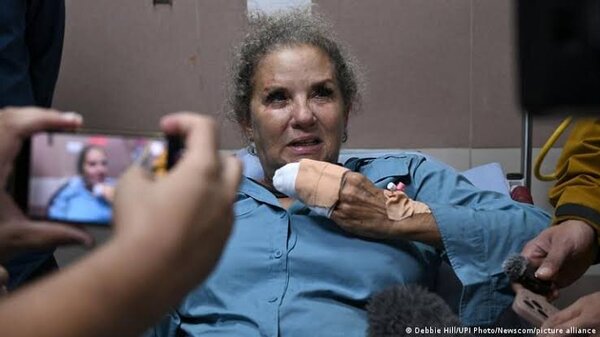
With the support of the Israeli military, Zionist settlers continue to commit crimes against Palestinians in the occupied Palestinian territories. Yet the wounding of Heidi Levine, a photographer for The Washington Post, during settler violence in the West Bank has prompted a markedly different response from Western officials and media outlets. This disparity once again exposes Western exceptionalism and the double standards applied to human rights: a framework in which the value of human life and the importance of press freedom are judged not according to universal principles, but according to the victim’s identity and relationship to dominant powers.
Violence, in any form and by any means, is condemnable. The central issue, however, is the selective treatment of victims. When the war in Ukraine began, some Western media and political figures emphasized the victims’ European identity, blue eyes and blond hair, contrasting them with people in the Middle East, as though the suffering and displacement of Europeans deserved greater sympathy because of their identity and appearance. This approach is a clear manifestation of a hierarchical view of human beings, one that is now evident in the response to the assault on an American journalist.
Mike Huckabee, the US ambassador to the occupied territories, described the attack on Heidi Levine as a “horrific act of terrorism carried out by cowardly masked men.” His position, viewed alongside his views on Israel’s purported religious right to control large parts of the Middle East and his opposition to describing the crimes in Gaza as genocide, reveals a telling contradiction. US Secretary of State Marco Rubio also described images of the journalist being assaulted as troubling and said Washington had asked Israel to address settler violence. The question is: Why is the same level of concern not shown for the decades-long suffering of Palestinians?
Press Freedom: A Privilege Determined by the Victim’s Identity
Western media outlets, which for years have responded to organized settler violence against Palestinians with restrictions, silence or disproportionate coverage, are now emphasizing Heidi Levine’s vulnerability by highlighting details such as her helmet and press vest. Concern for journalists’ safety is essential and entirely justified. The issue is not sympathy for an American journalist, but the lack of comparable concern for Palestinian journalists and other reporters who fall victim to occupation.
Freedom to disseminate information and the protection of media workers are universal rights. They cannot be made conditional on a journalist’s citizenship, nationality or political alignment. When these principles are demanded loudly for one group but violations of the same rights against another are met with silence, claims of commitment to shared human values lose their credibility.
From Gaza to Lebanon: Journalists Who Paid for the Truth With Their Lives
The Zionist regime’s record in its treatment of journalists paints a grim picture of the cost of independent reporting. Amal Khalil, a journalist for Lebanon’s Al-Akhbar newspaper, was killed in an attack attributed to the Zionist regime. Shireen Abu Akleh, an Al Jazeera journalist, was also shot and killed while covering an Israeli military raid in Jenin. These cases, alongside reports of widespread threats against journalists, show that media work in the occupied territories and Gaza carries serious risks.
The United Nations Office of the High Commissioner for Human Rights has described Gaza as the most dangerous place in the world for journalists. The Gaza government media office has also reported that more than 260 journalists and media workers have been killed in the enclave since the war began in October 2023. Regardless of the need to examine each case carefully, these figures reveal the scale of a catastrophe whose moral and legal implications cannot be evaded through silence or by dismissing the deaths as ordinary wartime casualties.
From Palestine to Minab: The Scandal of Selective Human Rights
From Palestine to Minab, the central issue remains the double standards of those who claim to defend human rights. When the media serves the narrative favored by Western powers, freedom of expression and the protection of journalists become urgent demands. But when journalists report on the suffering of oppressed peoples and the crimes of the US and the Zionist regime, silence, censorship and the downplaying of victims take the place of those same principles.
In such an environment, the media can become a tool for shaping public opinion, legitimizing political pressure and laying the groundwork for destabilizing countries, while the accounts of victimized peoples are pushed to the margins. Today’s war is also a war of narratives, a battlefield in which the roles of oppressor and oppressed are reversed, aggression is presented under the guise of security, and defense and resistance are labeled terrorism.
The assault on an American journalist is condemnable in its own right. But condemning violence in a meaningful way requires that condemnation not depend on the victim’s nationality. From Gaza to Minab, the measure of human rights credibility is not the intensity of public condemnations or media campaigns, but the extent to which equal human rights are upheld in practice. Strengthening public media literacy and establishing independent information structures are essential to countering censorship, one-sided narratives and the whitewashing of crimes. These efforts are necessary to ensure that victims’ voices can be heard beyond the boundaries of power.