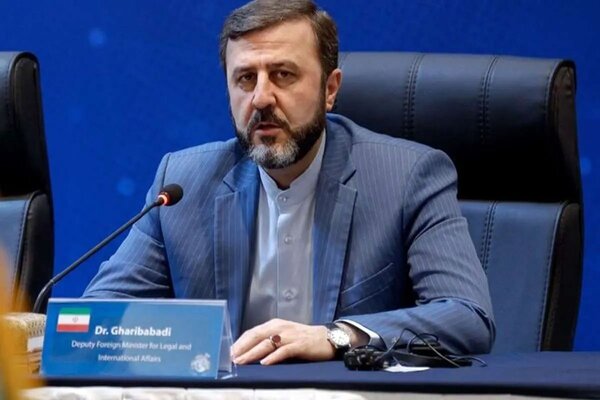
Speaking at the 7th Summit of the Conference on Interaction and Confidence Building Measures in Asia (CICA) held in Baku, Azerbaijan, on Thursday, Gharibabadi outlined Iran’s positions regarding regional and international developments, as well as the security situation in Asia.
He said today’s summit takes place at a time when Asia — despite its immense human, economic, and civilizational potential — faces a range of complex security threats.
“One of the most significant challenges currently facing the international order is the normalization of the use of force, alongside attempts to impose political will upon independent nations through military aggression, sanctions, and threats”, Gharibabadi said.
He added that the Islamic Republic of Iran has been subjected to military attacks — assaults that constitute a blatant violation of Iran’s national sovereignty and territorial integrity and run counter to the fundamental principles of international law, international humanitarian law, and the United Nations Charter.
“Since February 28, our nation has — for the second time in the past 16 months — faced illegal military aggression by the United States and the Zionist regime, an act of aggression that was launched precisely while intensive diplomatic negotiations were underway,” he said.
Gharibabadi noted, “On the very first day of this aggression, the Leader of the Islamic Revolution was martyred, and many of our compatriots — including 168 innocent schoolchildren from the Shajareh Tayyebah school in Minab — lost their lives. Peaceful nuclear facilities, which were under the supervision of the International Atomic Energy Agency (IAEA), as well as vital civilian infrastructure, were targeted. In response to this aggression, Iran has exercised its inherent right to legitimate self-defense, in accordance with Article 51 of the UN Charter. We are not a warmongering nation, but any act of aggression will be met with a decisive response from us.”
The Iranian deputy foreign minister described the United States and the Zionist regime as the primary sources of insecurity and lawlessness in the world, warning that if the international community fails to stop them today, their aggressions will extend to all independent nations.
The US considers itself the law and has dismantled international regimes; meanwhile, the Zionist regime is not a party to any international disarmament or arms control treaties, has developed all types of weapons of mass destruction, has launched military attacks against its neighbors and other nations in West Asia, and has become the embodiment of aggression and malevolence both regionally and globally, Gharibabadi said.
He added that the Zionist regime’s military actions, continued occupation of Palestinian territories, violation of the rights of the Palestinian people, and escalation of tensions in Lebanon, Syria, as well as other parts of the region are key factors contributing to instability in West Asia.
The expansion of military confrontation and threats of attack against regional countries increase the risk of involving additional actors and spreading the crisis to other parts of Asia, he said, adding that the Islamic Republic of Iran believes that one cannot speak of sustainable security in Asia while remaining indifferent to occupation, aggression, military threats, and the violation of the rights of the Palestinian nation.
He emphasized that the persistence of the current situation — particularly in the absence of effective accountability and the enforcement of international rules — undermines the credibility of the international legal order, conveying the dangerous message that military power can serve as a substitute for the law.
Gharibabadi underlined, “We call for an end to the aggressive actions of the United States and the Zionist regime, the termination of impunity, the protection of civilians, and the pursuit of legal accountability within the framework of competent international mechanisms.”
Noting that the Zionist regime constitutes the primary source of insecurity and instability in Asia — particularly in the West Asia region — Gharibabadi said countries are expected not to remain silent in the face of this regime’s brutal crimes against various countries — crimes perpetrated with the backing of its “big brother”, the United States.
“The time has now come for this regime to be expelled from the CICA mechanism,” he said.
Gharibabadi stressed the importance of maintaining friendly relations with neighboring countries and preventing their territories from being used to launch attacks against Iran, while reaffirming Iran’s right to self-defense.
He said the current problems stem from military aggression against the Islamic Republic of Iran and a naval blockade, stressing that maritime security is inseparable from the security of coastal states.
The Iranian deputy foreign minister stressed that the only practical way to restore regional peace, order and ensure safe passage through the Strait of Hormuz is to permanently end aggression and war, fully lift the naval blockade and sanctions against Iran, and respect the country’s sovereignty and territorial integrity.