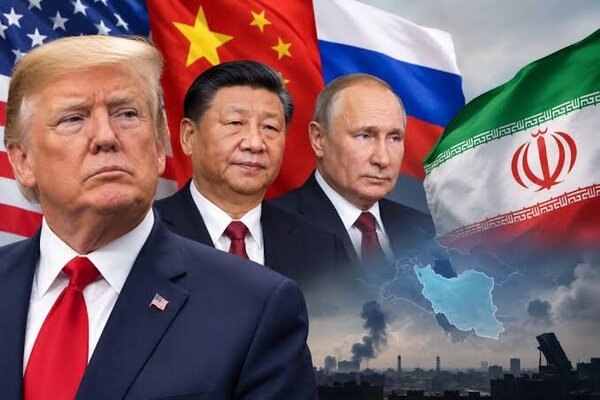
Nournews: Donald Trump, facing economic pressures, the rising costs of confrontation with Iran and concerns over the electoral consequences of his policies, is seeking to portray Iran as isolated and Washington as strategically dominant by denying that China and Russia are assisting Tehran. He has claimed that Beijing and Moscow have no incentive to help Iran and that the United States would quickly find out if they did.
Beyond being a political statement, this position contains a significant contradiction: If Iran has managed to withstand pressure from the United States and Israel and influence regional dynamics without direct military backing from the two powers, how can that reality be interpreted as evidence of Tehran’s strategic weakness?
From this perspective, Trump’s remarks should be examined both as an attempt to downplay Iran’s ties with its eastern partners and as part of Washington’s effort to reshape the narrative surrounding its own shortcomings. Such a narrative could also pave the way for further pressure on Tehran.
An Unintended Admission of Iran’s Indigenous Strength
Trump’s remarks about China and Russia having no incentive to help Iran, regardless of whether the claim is accurate, raise a fundamental question: If Tehran is not receiving direct military support from the two powers, what accounts for its ability to withstand extensive military and economic pressure?
The answer lies, first and foremost, in Iran’s indigenous capabilities, defensive and missile capabilities, the operational experience of its armed forces, its geopolitical position and its ability to influence regional security dynamics. Together, these factors form a set of deterrent capabilities that cannot be assessed solely on the basis of the level of foreign support Iran receives.
Trump previously spoke of rapidly destroying Iran’s military capabilities and delivering a decisive blow to its infrastructure. However, the continuation of the confrontation and Iran’s retention of its ability to respond have raised serious questions about the extent to which Washington has achieved its stated objectives. Under these circumstances, emphasizing the absence of Chinese and Russian military assistance does not, by itself, demonstrate Tehran’s isolation. Instead, it draws attention to the importance of Iran’s domestic capabilities.
The Strait of Hormuz is also significant in this context. Iran’s position along this strategic waterway, and the impact of any disruption to maritime traffic on global energy markets, demonstrate that Tehran’s geopolitical leverage is part of its deterrence equation. Higher transportation costs, pressure on fuel markets and difficulties in restoring normal conditions are among the consequences that extend the confrontation beyond the military arena and into the global economy.
The central question, therefore, is not simply how much China and Russia are helping Iran. The more important question is why the United States, despite its extensive military and economic resources, has been unable to achieve all its declared objectives. By emphasizing the absence of direct military support from the East, Trump inadvertently highlights the question of how much Iran’s ability to exert influence rests on its own independent and indigenous capabilities.
Why Does Trump Want to Downplay China and Russia’s Role?
Trump’s remarks should also be analyzed in the context of the battle over the narrative of the war and Iran’s standing in the international arena. By emphasizing the claim that Beijing and Moscow have no incentive to help Tehran, Washington seeks to convey two messages: first, that Iran lacks meaningful support from major powers; and second, that the United States is in a position to pursue its policies without worrying about a serious response from those powers.
This narrative may serve other purposes as well, including casting doubt on the effectiveness of Iran’s ties with the East, undermining expectations of expanded international cooperation and promoting the perception that Tehran will ultimately be forced to yield to Washington’s demands under US pressure.
However, two issues must be distinguished here: the absence of direct military support in a war does not necessarily mean that strategic relations or political and economic cooperation are lacking. Relations between countries have multiple dimensions, and cooperation in diplomacy, trade, science, technology and security cannot be assessed solely by whether military equipment is supplied.
Frequent meetings among Iranian, Russian and Chinese officials, cooperation within the Shanghai Cooperation Organization (SCO) and BRICS, long-term economic agreements and shared positions in certain international forums all point to continued engagement among the three countries. Such cooperation, however, does not amount to an unlimited military alliance or an automatic commitment by Beijing and Moscow to enter the war directly. All three countries make decisions based on their own national interests, and they may also disagree on certain issues.
Nevertheless, differences in interests or limitations on the level of military support cannot be equated with Iran’s isolation. China and Russia may take approaches to managing their confrontation with the United States that differ from Tehran’s, but those differences do not, in themselves, mean that relations among the three countries are ineffective.
Trump’s claim, therefore, could constitute a credible strategic argument only if it explained not just the level of military support Iran receives, but also the actual impact of Tehran’s ties with the East on its economic, diplomatic and regional capabilities. Reducing all these relationships to the question of military assistance presents an incomplete picture of international relations.
Denying Eastern Support: A Prelude to Greater Pressure or a Cover for Failure?
One important aspect of Trump’s remarks is their connection to Washington’s efforts to reshape Iran’s calculations. If the United States is raising the issue of a lack of Chinese and Russian support to portray Tehran as strategically isolated, the remarks should be seen as part of a broader campaign to shape perceptions. In this context, military and economic pressure is accompanied by efforts to influence how the opposing side perceives the balance of power.
Trump’s comments about the difficulty of negotiating with Iran and the uncertainty over who makes the decisions in Tehran can also be examined within this framework. The US president has spoken of the difficulty of identifying Iran’s negotiating counterpart, while his vice president, JD Vance, has previously commented on how confident Washington can be about the decision-making process at Iran’s highest levels.
These positions lend themselves to at least two interpretations. Under the first, the US administration is seeking to attribute its diplomatic difficulties to the complexity of Iran’s decision-making structure and shift responsibility for a potential negotiating deadlock onto Tehran. Under the second, emphasizing this issue may be part of Washington’s effort to influence Iran’s internal calculations and sow doubts about the possibility of reaching an agreement.
There is another possibility: The United States may seek to increase military and security pressure while downplaying Iran’s foreign support, in an effort to bring Tehran closer to accepting US terms. In such a scenario, denying China and Russia’s role would not necessarily signal an imminent new attack. Rather, it would form part of a narrative designed to raise the cost of resistance for Iran and portray continued confrontation as an increasingly unattractive prospect for Tehran.
However, these remarks alone do not establish that Washington has made a firm decision to launch another round of attacks or assassinations. Such an assessment would require independent evidence, including military movements, operational decisions and measurable changes in US behavior.
The key point is that Washington wants to turn the absence of direct military support from the East into evidence of Iran’s weakness. Yet this claim, on its own, neither establishes the extent of Tehran’s defensive capabilities nor proves that the US strategy has succeeded.
The Contradiction in Trump’s Narrative: If Iran Is Isolated, Why Is It So Difficult to Contain?
Ultimately, Trump’s remarks should be assessed against the backdrop of the struggle to define the outcome of the confrontation with Iran. To project strength to the American public and foreign allies, the US administration needs a narrative in which Washington retains the initiative and Tehran is portrayed as being in a position of weakness. Downplaying Iran’s ties with China and Russia may be part of that narrative, but its effectiveness depends on how closely it aligns with realities on the ground and in the political arena.
If Iran is not receiving direct military backing from China and Russia but can still preserve its defensive capabilities, influence the dynamics surrounding the Strait of Hormuz and raise the economic costs of confrontation, these factors cannot be explained solely in terms of international isolation. Conversely, if Tehran’s economic and diplomatic relations with Beijing and Moscow continue, claims that Iran is completely isolated become even more questionable.
This does not mean, of course, that Iran’s limitations should be overlooked or that its eastern partners should be assumed to have unlimited commitments to it. International relations are shaped by changing interests, and relying strategically on any foreign partner without taking account of its constraints and priorities can lead to miscalculation.
For this reason, ties with the East become more valuable when they help expand Iran’s diplomatic and economic options while strengthening its indigenous capabilities.
With regard to the Strait of Hormuz, too, the prudent management of Iran’s geopolitical position, the preservation of deterrence and a careful assessment of the consequences of reciprocal actions are crucial. Any escalation could generate costs extending well beyond the military arena, affecting energy, trade and regional security.
By denying that China and Russia are supporting Iran, Trump is seeking to shift the focus from the shortcomings of US strategy to Tehran’s alleged isolation. But this shift in the narrative leaves a fundamental question unanswered: If Iran lacks meaningful foreign backing, how has it become an influential actor in the region’s military and geopolitical calculations?
The answer lies not in accepting Washington’s claims uncritically, but in assessing Iran’s indigenous capabilities, the limits of its cooperation with eastern powers and the actual results of US policies together. In this context, neither should foreign support be exaggerated nor should the role of Iran’s international relations be dismissed by denying it.
What matters is the gap between Trump’s political narrative and the measurable realities on the ground. That gap will help determine whether Washington’s pressure campaign moves closer to achieving its stated objectives or once again runs up against strategic limitations.