
A miscalculation about Yemenis’ capabilities, coupled with reliance on a security umbrella promised by foreign powers, has contributed to the continuation of Saudi Arabia’s attacks on Yemen and the responses by Ansar Allah and the Yemeni army under the right to self-defense. The continuation of a war between two Muslim countries serves no purpose other than advancing the interests of the Zionist regime and the enemies of the Islamic world. Against this backdrop, Iran has continued, as in previous years, to pursue dialogue between Saudi Arabia and Yemen, drawing on the principles of indigenous security and region-centered diplomacy.
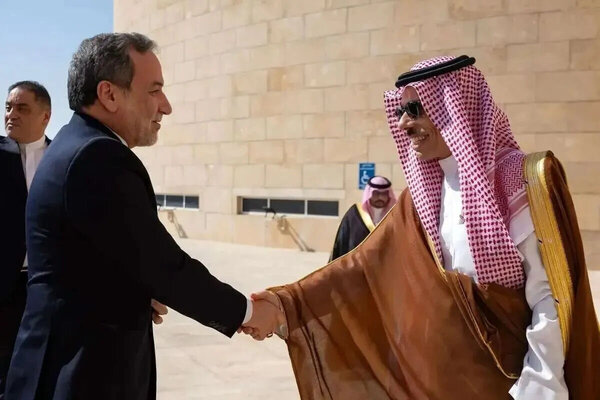
In a phone call with his Saudi counterpart, Faisal bin Farhan, Iranian Foreign Minister Abbas Araghchi expressed concern over escalating tensions and stressed that insisting on a military approach while disregarding a political solution would further complicate the situation. He declared Iran’s readiness to provide any assistance necessary to initiate dialogue between Saudi Arabia and Yemen and reach a political settlement. Beyond reflecting Tehran’s assessment of the situation, this position offers regional countries an opportunity to rely on their own capabilities, replace dependence on foreign powers with indigenous security arrangements, and play a role in the emerging world order.
From the Beijing Agreement to Mediation for Peace in Yemen
Tehran has consistently viewed comprehensive relations with Riyadh as serving the interests of both countries, the region, and the Islamic world. After seven years, Iran’s welcoming of China’s initiative to resolve misunderstandings led to the Beijing Agreement, a process that demonstrated the importance of dialogue and political will in easing tensions.
The late Rear Admiral Ali Shamkhani, then secretary of Iran’s Supreme National Security Council, emphasized the significance of the agreement, stating: “Resolving misunderstandings and adopting a forward-looking approach in Tehran-Riyadh relations will undoubtedly contribute to greater regional stability and security, as well as increased cooperation among Persian Gulf countries and the Islamic world in managing existing challenges.”
The numerous meetings between officials from the two countries in recent years can also be assessed within this framework. Even during the Ramadan War, despite widespread tensions, Iran did not target Saudi Arabia and instead directed its attacks at US bases, interests, and targets. Tehran’s current offer to facilitate dialogue between Riyadh and Sanaa is a continuation of the same engagement-oriented approach and a sign of efforts to strengthen convergence among neighboring countries.
The “Proxy” Label: Denying the Agency of Regional Nations
Media outlets and opponents of regional convergence seek to revive a scenario of brother against brother and Arab against Persian by repeatedly using the label “proxy” and promoting politically motivated terminology. Such labels, however, do not change the reality of nations’ own agency. The fundamental difference between Iran’s outlook and that of the hegemonic system lies in its emphasis on independence, good-neighborly relations, and shared progress, as opposed to exploiting countries and groups to serve foreign interests. Iran’s fight against ISIS and its technical and scientific cooperation are also examples of this approach.
The emergence of popular resistance movements in Iraq, Lebanon, Palestine, and Yemen has taken place in the context of opposition to occupation, aggression, and structures dependent on foreign powers, demonstrating the role of indigenous agency. Reducing these movements to Iranian proxy forces ignores the nations’ aspirations for independence and repeats the same strategy that seeks to break their will by undermining their dignity.
Strategic Initiatives: From the Four-Point Proposal to Indigenous Security
Since Saudi Arabia and its regional allies launched military attacks on Yemen with Western support, Iran has regarded the military option as a failed path and a political solution as the only sustainable alternative. Tehran’s four-point initiative—calling for an immediate halt to aggression, the delivery of essential and humanitarian aid, inclusive national dialogue involving all Yemeni groups, and the formation of a national reconciliation government—can still serve as a realistic basis for negotiations.
Recent developments have also highlighted the costs of relying on the US security umbrella. These include the Ramadan War and what has been characterized as US betrayal of Arab countries by prioritizing the Zionist regime; the vulnerability of US bases and forces; the continuing humanitarian catastrophe in Gaza and the failure of purported peace mechanisms; Washington’s gas deal with Russia and its implications for Europe and Ukraine; and the Strait of Hormuz crisis following US actions that have heightened tensions. These developments underscore the need to reconsider security dependence and strengthen regional cooperation.
Iran’s diplomatic record extends beyond its initiative on Yemen. Its welcoming of mediation efforts by Qatar, Pakistan, and Oman to end the war; its Strait of Hormuz peace proposal and its initiative for a meeting of Persian Gulf and Gulf of Oman littoral states; its hosting of Afghan groups to bring their positions closer together; its negotiations aimed at improving Iraq’s security; and its calls for an end to fighting on all fronts within the framework of the Islamabad Memorandum of Understanding are among these efforts.
Today, alongside relying on its armed forces and exercising strategic management of the Strait of Hormuz, Iran is also using its diplomatic capacity to reduce tensions. Araghchi’s proposal concerning Yemen and Saudi Arabia is a clear example of this approach. Regional countries’ use of such diplomatic opportunities could help end the war, strengthen indigenous security, and expand West Asia’s role in the emerging world order.