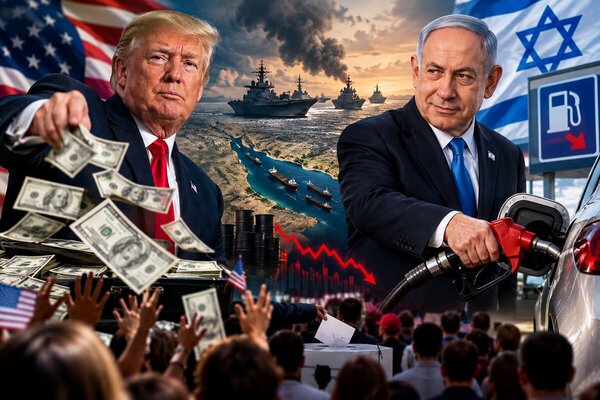
Nournews: The proposal to pay $5,000 to every American adult, conditional on Republicans maintaining control of Congress, is more than an economic pledge. It amounts to a direct political bargain: if my party stays in power, you get the money. Reuters has estimated the potential cost of the plan at around $1.2 trillion, plus interest, and reported that even Republicans themselves are divided over its consequences.
But the story does not end with this promise. As the midterm elections approach, the Trump administration has also moved to issue $500 checks linked to health insurance. A large share of these payments would go to states where the electoral race is particularly competitive, prompting criticism that the measure could serve an electoral purpose.
In Israel, meanwhile, Netanyahu and his finance minister have cut the fuel tax by half a shekel just ahead of the October 27 election, bringing the price of gasoline down from 8.27 to 7.77 shekels. The cut came after concerns were raised over the legality of such a move so close to the election. The cost to the state treasury has been estimated at around 150 million shekels a month.
The issue here is the conduct of those in power who, as election day approaches, suddenly turn people's wallets, gasoline prices and public resources into tools for maintaining political power.
A War Whose Bill Is Paid by the Public
Behind these electoral displays, however, lies a much bigger reality: the US-Israeli war against Iran has affected far more than the battlefield. It has also severely disrupted energy, trade, transportation and the global economy.
The Strait of Hormuz, through which nearly one-fifth of the world's oil and gas flows passed before the war, has become one of the world's most sensitive energy chokepoints. Even with some oil exports returning, logistics and insurance costs remain sharply elevated. Reuters has reported that tanker rates on some Persian Gulf routes have risen to around $1.2 million a day, compared with about $30,000 previously.
For ordinary people, the meaning of these figures is simple: more expensive fuel, more expensive transportation, higher production costs and, ultimately, more expensive goods and services.
The effects of the crisis have also become visible in the United States. Consumer confidence fell in September to its lowest level in about 12 and a half years, while rising energy and diesel prices, food costs and housing expenses added to public pessimism.
The war that was launched under claims of ensuring security and demonstrating strength is therefore confronting part of the US public with a very down-to-earth question: Why should the cost of decisions made in the White House be paid at the gas pump, in grocery carts and through household bills?
When War Becomes an Electoral Escape Route
Trump is now facing costs that cannot be hidden behind campaign slogans. A Reuters/Ipsos poll in September put his approval rating at 32 percent, the lowest level recorded during his political career. Only 17 percent approved of his handling of the cost of living, while support for the attacks on Iran stood at 34 percent.
These figures indicate that the Iran war has become a direct economic and domestic political issue for Washington. Rising energy and living costs have intensified public dissatisfaction, while Trump himself acknowledged on September 30 that he had done a “very bad” job explaining his administration's economic performance.
Under such circumstances, the temptation to use another foreign crisis as a way to escape a domestic crisis cannot be overlooked. A new war cannot be predicted, but continued military pressure, sanctions and threats against Iran, at a time when the existing war has already imposed heavy economic costs, could increase the risk of renewed escalation.
Netanyahu is facing a similar situation. A sharp increase in fuel prices following the war against Iran has forced his government to turn to a fuel-tax cut to ease economic pressure, a measure introduced precisely on the eve of the election.
The main risk in such circumstances is that, in an effort to protect their electoral positions, political leaders could further increase the costs already borne by the public as a result of the war by triggering another crisis.
From Cash Handouts to Another Gamble with War
If Trump and Netanyahu believe they can erase the war's bill from the public's view with a few financial promises, a temporary reduction in gasoline prices or heightened military threats, they will face a much larger reality.
War is not merely a matter of missiles and military attacks. It means disruption to trade, higher insurance premiums and shipping costs, surging energy prices, pressure on industries, increased transportation costs and the transmission of inflationary pressures into the lives of millions of people. Even as Middle Eastern oil exports reached levels above those seen before the war on some days in September, logistical and security problems continued to keep energy prices elevated.
Therefore, if the two leaders move toward a new escalation against Iran in an effort to avoid political setbacks and domestic discontent, Iran would not be the only party at risk. Energy markets, the global economy and the lives of citizens in the United States and Europe would once again be exposed to shocks and heavy losses.
But the more important calculation is in Tehran. Iran has so far stated that it has not abandoned its principles and conditions, and that military pressure, threats and sanctions cannot change its position. Reports concerning negotiations over the Strait of Hormuz have also indicated that Tehran has made the removal of military threats, an end to sanctions and compensation for damages among its conditions.
For Trump and Netanyahu, then, the issue is not simply the election. It is also the political cost of a policy that has brought war into the economy, energy markets and people's daily lives. Cash handouts may generate a few election headlines, fuel discounts may ease pressure for a few weeks, and military threats may create a few hours of excitement, but none of them can change the realities on the ground.
If elections become a marketplace for trading votes and war becomes a tool for avoiding accountability, it is not only the credibility of those in power that is at stake. The very meaning of people's votes and the economic security of millions of people are also being put at risk.