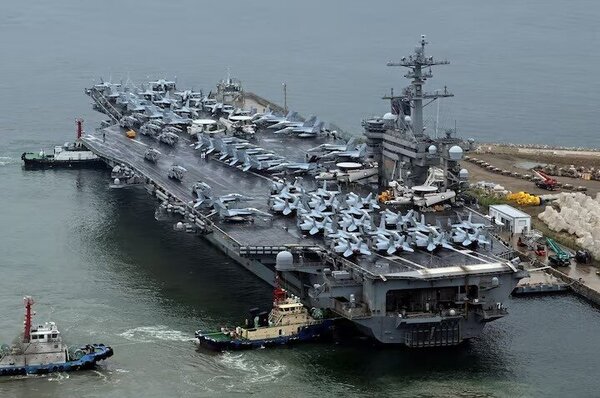
At a time when Trump lacks many of the conditions needed for a Republican victory in the congressional midterm elections, Western media are once again creating a major media narrative around the deployment of the aircraft carrier Theodore Roosevelt to the region. The Hill reported that the carrier has left its San Diego base and is heading toward the region. These outlets are seeking to portray the Roosevelt’s deployment as a demonstration of US power and even as a prelude to activating the military option if Iran refuses to surrender or if economic pressure succeeds in undermining national cohesion and the resilience of the Iranian people. Yet the fate of previous US carriers and Trump’s new methods of political messaging point to a different reality: the gradual diminishing effect of US carrier power projection. By contrast, repeated statements by political and military officials in Tehran that any miscalculation will draw a forceful response, and that the Strait of Hormuz will be reopened only after Iran’s conditions are met, demonstrate Tehran’s determination not to yield to pressure or threats.
Secrets Revealed by US Carriers
The United States is seeking to portray the Roosevelt’s deployment as a major development and a sign of Washington’s seriousness about taking action against Iran through both military and other options. Yet the fate of previous carriers has revealed realities that go beyond this display of power.
The aircraft carrier USS George H.W. Bush, after months of supporting US military operations in West Asia, has reached the vicinity of Thailand’s resort island of Phuket, carrying around 4,800 personnel who are expected to spend several days in the area. Earlier, the USS Abraham Lincoln made a five-day stop at Laem Chabang port in eastern Thailand, with around 5,000 US sailors and Marines aboard. The carriers that Trump describes as the most powerful tools for destroying America’s enemies not only failed to achieve a decisive outcome in the war against Iran, but were also forced to retreat in the face of Iranian missiles and drones. Even US military commanders have spoken about the ineffectiveness of their presence. Reports emerging from aboard the carriers also became a major military and ethical scandal for the US military, one that even their recreational stay in Thailand could not conceal. The Roosevelt is now heading to the region while America’s naval flagships have failed to demonstrate the necessary resilience in the face of Iran’s power, and the same fate could await the Roosevelt, particularly as Iran has simultaneously rebuilt its military capabilities and achieved new gains.
Hegseth and Signs of a Crisis in US Military
The White House remains fixated on projecting military power, but the sweeping and sudden changes made by War Secretary Pete Hegseth to the structure of the US military point to developments extending beyond battlefield performance. The basic logic of war is that military commanders, particularly during an ongoing conflict, are not replaced when they have reliable achievements to their credit. Major changes generally occur when either serious failures have been recorded or widespread disobedience of orders has emerged.
Reports from within the US Department of War indicate that the country’s military objectives against Iran have not been achieved, while declining weapons stocks and damage to US bases in the region have become a strategic crisis. At the same time, opposition among some military commanders to continuing the war against Iran, citing its high costs and the inability to achieve victory, is another indication of this crisis. Hegseth’s sweeping changes, beyond his personal ambitions to remove some senior figures, may be another sign of the depth of the crisis within the US military. Under these circumstances, the Roosevelt’s deployment looks less like an effort to achieve a concrete result than a display that could usher in a new phase of US military embarrassment.
A Military That No Longer Brings Reassurance
White House officials, from Trump and Vice President JD Vance to the Treasury secretary and Hegseth, continue to promote a narrative of achievement using slogans such as the destruction of Iran and the passage of billions of barrels of oil through the Strait of Hormuz. But markets do not move according to political narratives; they respond to realities on the ground. Rising oil, gasoline and diesel prices show that military displays are no longer capable of restoring calm to America’s economic and social environment as they once did.
In the past, displays of US military power, from the occupations of Afghanistan and Iraq to the war in Libya, had significant effects on the US economy and public attitudes. Today, however, this instrument has lost much of its previous effectiveness. Widespread dissatisfaction with Trump’s performance, rising prices, declines in financial markets and the condition of the bond market all point to this reality. Exaggerating the Roosevelt’s deployment is therefore unlikely to calm the turbulent waters of the US economy and society, a storm that could have a devastating impact on the elections and directly affect the Republican vote.
Military Posturing Under the Shadow of an Electoral Defeat
Although the military option and the Roosevelt’s role remain prominent themes in the rhetoric of US leaders, reliance on economic warfare, Trump’s $5,000 promise for those who vote Republican, claims about Russian-US oil negotiations, Treasury Secretary Scott Bessent’s admission that Americans are being crushed by economic pressures, State Department claims about expelling Iranian diplomats from the UN General Assembly, and even efforts to engineer an electoral coup in Brazil to manufacture a political achievement all indicate that the military option no longer has the same propaganda value it once did.
A Reality That Will Not Change
Whether the Roosevelt has been deployed for war, to project power or to serve Trump’s electoral strategy makes no fundamental difference. The Strait of Hormuz will be reopened only if Iran’s conditions are met, and any miscalculation will face a response that is tougher, faster and broader than before. The reality is that regional equations are no longer determined solely by US decisions. The principles and framework of resistance will play a decisive role in shaping the future. Iran, drawing on its military power, the presence and resilience of its people, and its diplomatic strength, has also demonstrated its resilience and refusal to surrender.