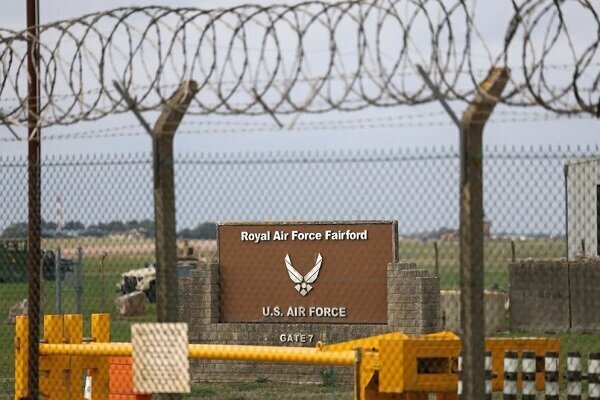
Nournews: It had not been long since the identities of the five suspects in the alleged attack on the U.S.-controlled RAF Fairford base were made public and the suspects were released when British police announced the arrest of a 27-year-old Iranian-British dual national on suspicion of preparing for terrorist acts. At the same time, British Prime Minister Andy Burnham told the BBC that Iran had played a “role” in the incident.
But the swift release of the five initial suspects has raised a fundamental question over London’s narrative: if these individuals were, as the British media climate appeared to suggest, a security threat linked to foreign governments, why were they released? Iranian Foreign Minister Abbas Araghchi has also pointed to this contradiction, describing it as an indication that the search for a culprit may be taking a different path.
London’s leaders have once again turned to the worn-out scenario of Iranophobia. Despite the withdrawal of U.S. forces and their allies from Iraq, Britain cannot simply whitewash the crimes it committed there, including the use of depleted uranium, which has been linked to cancer among hundreds of thousands of Iraqis. Nor can it cover up its involvement in U.S.-Israeli crimes against the Iranian people during the Ramadan war, to which NATO Secretary General Mark Rutte has officially acknowledged. Rather than posing as a victim, London should answer for its actions from Afghanistan and Iraq to Gaza and Tehran.
Therefore, even without accepting the hypothesis that the Fairford incident was orchestrated domestically, the possible role of groups backed by London, as well as the potential interests of allies such as the United States and Israel, cannot simply be dismissed through a hasty accusation against Iran.
Domestic Crisis Behind the Foreign Accusations
The timing of Burnham’s remarks is also noteworthy. The claims were made during the Labour Party’s annual conference in Liverpool and in an interview with the BBC, a broadcaster which, according to the narrative presented, had placed Iran and Russia under suspicion from the earliest hours of the Fairford incident without providing clear evidence.
These accusations have emerged as the British economy continues to face serious pressure. From October 1, the energy price cap increased by four percent, leaving around 22 million households covered by the tariff facing higher gas and electricity costs. At the same time, inflation and unemployment remain among the major challenges facing the British economy.
Under such circumstances, securitizing the political environment and shifting public attention from cost-of-living problems toward an external threat could be attractive to the government in London, particularly a government that came to power promising to improve the economic situation. From this perspective, Fairford is more than a security case; it has become another arena for reproducing Iranophobia.
From Fairford to Flydubai: Security in the Service of Political Theater
Trump’s entry into the Fairford case, alongside Netanyahu’s security narrative surrounding the Flydubai incident, raises the question of whether two separate cases have been placed within the same media environment to highlight the “Iranian threat.”
In this context, projecting intelligence and security dominance is politically significant for both Trump and Netanyahu. In the United States, opposition among a significant segment of the public to war-related actions against Iran, coupled with electoral pressure on Republicans, and in Israel, Netanyahu’s political situation, have increased the importance of exploiting security cases for political purposes.
At the same time, London’s foreign policy continues to oscillate between claims of support for Palestine and practical participation in Western military actions—from arms support for Israel to involvement in the war against Yemen and alignment with pressure policies against Iran. Protests by thousands of people at more than 40 locations across Britain against the country’s National Health Service working with the U.S. company Palantir have also highlighted the gap between London’s human-rights claims and its actions.
Straits Cannot Be Opened by War and Accusations
On the one hand, London is accusing Iran in an apparent effort to justify its participation in U.S. military and economic pressure; on the other, through its involvement in military actions against Yemen, it is seeking to keep Western shipping routes open. But the fundamental issue is that pressure and threats do not necessarily produce the outcome sought by Washington and London.
Attempts to open the Strait of Hormuz or Bab al-Mandab through threats, war and Iranophobia could backfire and exacerbate the energy and transportation crisis. Under such circumstances, the more London spends on external deflection, the longer the domestic factors behind its economic crisis will remain in place.
For Britain, the issue is not merely a security case. Fairford could be part of a larger puzzle in which domestic crisis, external pressure, efforts to curry favor with Washington and Tel Aviv, and attempts to reopen maritime routes are all intertwined. But straits cannot be opened through narrative-building, and domestic crises cannot be eased by accusing others.