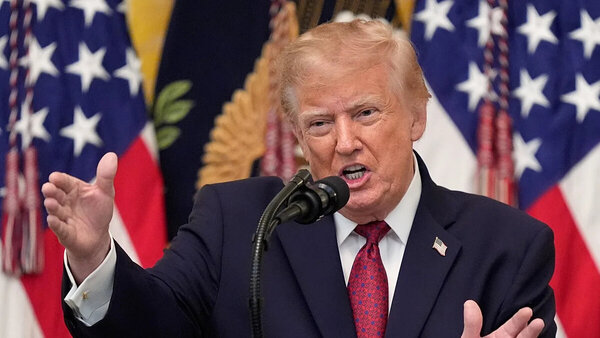
Donald Trump has repeatedly spoken in recent months of the defeat, destruction and collapse of Iran’s capabilities. Two more remarks he made on the evenings of September 30 and October 1 brought the total number of such claims to 94. In his latest statements, Trump again spoke of the destruction of Iran’s capabilities while simultaneously referring to the need for an agreement or continued military action. The rhetoric shows that the narrative of “Iran’s end,” despite its constant repetition, has yet to replace the complex reality of the war.
The issue is not simply how many times Trump has spoken of Iran’s defeat. The question is why, after repeating the claim 94 times, Washington is still talking about ending the war, reaching an agreement, applying pressure and the possibility of continued military operations. If what the US president calls “destruction” were a final reality, the war should have reached its conclusion rather than remaining on the White House’s political and security agenda.
From the Promise to Destroy Iran to America’s Bill
The war that Washington launched with a sweeping display of military power has now generated a heavy bill inside the US as well. The Congressional Budget Office estimated the war’s direct cost at about $38 billion through August 1 and said the figure could rise by another $2 billion to $3 billion per month. A subsequent estimate by US Central Command put the cost of the war at about $43.6 billion by early September, a figure that does not fully include the potential costs of rebuilding some damaged US facilities.
But the war’s bill is not limited to the Pentagon budget. Higher energy prices represent another cost that has been passed directly on to Americans. An estimate by the Institute on Taxation and Economic Policy shows that higher fuel and energy prices resulting from the war had imposed more than $100 billion in additional costs on US consumers by September 24, with the average additional household cost estimated at about $750.
The Congressional Budget Office has also warned that the war could add about half a percentage point to US inflation in the first quarter of 2027, while increasing borrowing costs for households and businesses. The consequences of the war are therefore no longer visible only on operational maps in West Asia; part of the cost has been transferred to fuel prices, inflation, public finances and the cost of living for Americans.
At this point, one of the war’s key contradictions becomes apparent: a government that entered the war promising to demonstrate power and impose costs on Iran is now facing tens of billions of dollars in military expenses, pressure on critical ammunition stocks and higher energy costs for its citizens. Even official reports about declining ammunition stocks and the need for years to replenish some of them show that the cost of war is not merely an accounting figure; it is also affecting America’s future capabilities.
Minab, Lamerd and Kuhestak: Human Cost of War
On the other side of the equation are the people of Iran, who have paid the human cost of the war. The US attack on Shajareh Tayebeh School in Minab resulted in the deaths of numerous students and civilians, while human rights organizations warned of serious violations of international humanitarian law and called for an investigation into those responsible for the incident.
International reports also documented civilian casualties in Lamerd. In Kuhestak, munitions struck a wedding ceremony, killing and injuring dozens of people. Examination of remnants at the scene also pointed to the use of US-made guided munitions.
These incidents cannot simply be treated as peripheral to a military operation. Schools, homes and wedding ceremonies are centers of civilian life. When such places are struck, questions arise regarding legal responsibility, the principle of distinction between military and civilian targets, proportionality and precautions in attack. A war that Washington’s rhetoric presented as a demonstration of military power and precision took on a distinctly brutal and bloody face, particularly in these locations.
Did the Narrative of Defeat Defeat Itself?
The number 94 now provides a line along which the gap between claims and consequences can be seen. Trump has repeatedly spoken of Iran’s defeat and destruction, yet Iran has maintained its political structure, retained a significant capacity to respond and remained active diplomatically. Meanwhile, the US faces a multibillion-dollar war bill, pressure on ammunition stocks and energy supplies, rising energy costs and inflation concerns.
The repeated narrative of “Iran’s defeat” has therefore not brought the war to an end. Instead, the consequences of the same war have returned to the US, affecting everything from the federal budget and weapons stocks to gasoline prices and the living costs of American families. A war that was supposed to be paid for by Iran has now generated a growing bill of tens of billions of dollars for US taxpayers and consumers as well.
Under these circumstances, the number 94 has become a symbol of the gap between the narrative of victory and the war’s bill. Each time Trump speaks of Iran’s defeat or destruction, another reality stands against the claim: Iran remains standing, while the costs of the war have simultaneously spilled over into the US economy and the lives of its people.
The final question is this: If the war was supposed to demonstrate an American victory, why is its conclusion still shrouded in negotiations and threats, and why have its costs moved beyond the battlefield and reached the pockets of US taxpayers and American families?