In a post on his X account on Thursday, Esmaeil Baghaei was responding to comments by US media personality and former Fox News host Tucker Carlson about a conversation he said he had with Trump in the Oval Office days before the war began.
In a short clip attached to his post, Baghaei quoted Carlson as saying he had warned Trump that the war was not about Iran’s nuclear program and that Israel was pushing the United States towards war.
“I said this to Trump to his face in the Oval Office, days before the war began. And he looked at me and said: ‘Yes, you’re right. But in the end, we all die anyway. So it doesn’t matter.’ That’s exactly what he said,” Carlson stressed.
Baghaei opened his post by quoting the reported remark: “In the end we all die anyway, so it doesn't matter.”
“This is no conventional political statement; it echoes Albert Camus’s Caligula at the exact moment existential 'absurdity' curdles into tyranny - where the 'inevitability of death' is used to strip the living of their value. Because life ends, Caligula reasoned, the suffering of others is inconsequential,” the diplomat said, drawing a parallel with the play.
Baghaei said the danger is magnified by the destructive power available to modern states.
“The terrifying difference today is leverage. Caligula had only the primitive tools of Rome; modern nihilism commands vast stockpiles of mass destruction,” he stressed.
Caligula refers to the Roman emperor Gaius Caesar, notorious in historical tradition for cruelty, capriciousness, and megalomania. He is often cited as the archetype of the unhinged, absolute ruler who threatened to make his horse a consul and who terrorized Rome's elite.
“The greatest geopolitical danger is not a leader confronting mortality. It is a system that uses the inevitability of death to justify indifference to human suffering. ‘We all die’ is a fact; ‘so it doesn't matter’ is the leap where existential dread becomes a political weapon,” Baghaei wrote.
Baghaei also warned against attempts to appease such an approach.
“Those who think they can appease Caligula forget that the absurd recognizes no rule or contract. Appeasement buys no safety - it merely negotiates the order of the victims,” he said.
Carlson’s account was made publicly in an NPR interview released on September 24. He described Trump’s reported response as “nihilism” and said the future and the lives of people affected by the war do matter.
In an interview with Time magazine published Thursday, Trump was directly confronted over his repeated threats to “annihilate” Iran and the contradiction between those threats and his self-description as a “president of peace.”
“Last week, you said you might annihilate Iran. That was the word you used,” Trump was asked.
“Yeah, I would do that. It’s possible,” Trump replied.
“You’ve made versions of that threat before. You’ve also called yourself the president of peace,” the interviewer continued.
“Yeah,” Trump responded.
“How can the president of peace be calling for the annihilation of an entire people?” Trump was asked.
“Because by annihilating Iran, we’ve created peace in the world. With Iran, I don’t think you could ever have peace,” Trump said.
"My thing that I mention all the time is Iran cannot have a nuclear power because they are crazy and you can’t let crazy people have nuclear weapons," he added.
Trump’s outrageous remarks come despite the fact that Iran has never been found to be building a nuclear weapon.
For years, Iran’s nuclear program has been subjected to some of the most intrusive international inspections ever conducted. The International Atomic Energy Agency repeatedly inspected Iranian nuclear facilities and repeatedly confirmed their peaceful purposes, finding no evidence that Iran was constructing nuclear weapons.
The same conclusion was reflected in repeated US intelligence assessments. American intelligence agencies have repeatedly found no evidence that Iran had made the decision to build a nuclear weapon or was pursuing a nuclear-weapons program.
According to many American pundits and politicians, Trump launched the terrorist war on Iran on behalf of Israel under the assumption that an invasion would be as easy as the one in Venezuela and would provide the US with extraordinary clout, including access to the world’s second-largest natural-gas reserves and fourth-largest oil reserves, just as in Venezuela.
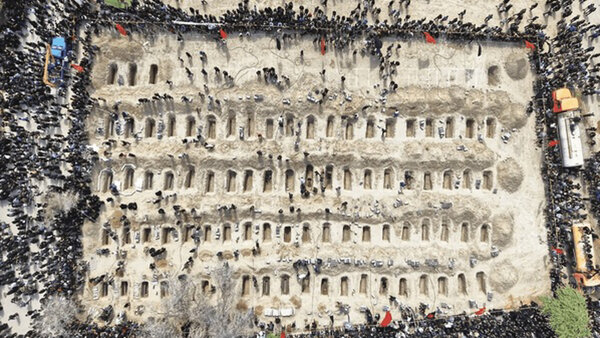
The two wars of aggression - the 12-day war in June 2024 and the 40-day war that began on February 28 - killed more than 4,500 Iranians and wounded over 70,000 others across the country.
On February 28, the first day of the 40-day aggression, US Tomahawk missiles struck Shajareh Tayyebeh Elementary School in Minab, Hormozgan Province, killing 168 people, most of them children and several teachers.