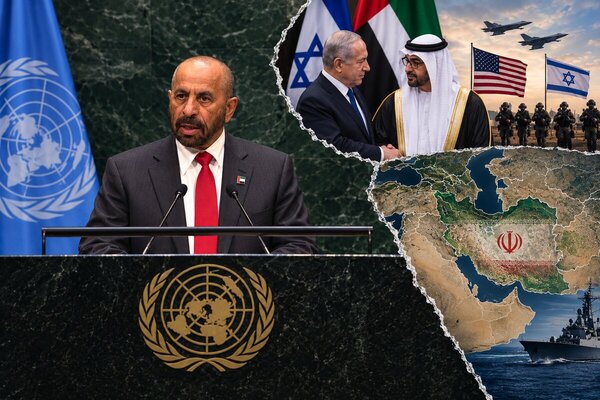
Nournews: At a time when West Asia is facing profound changes and widening divides, Khalifa Shaheen Almarar, the UAE’s Minister of State for Foreign Affairs, spoke at the 81st session of the UN General Assembly about de-escalation, dialogue, diplomacy and maintaining regional stability. He also stressed the importance of freedom of movement, maritime security and maintaining the flow of supply chains through the Strait of Hormuz in accordance with international law.
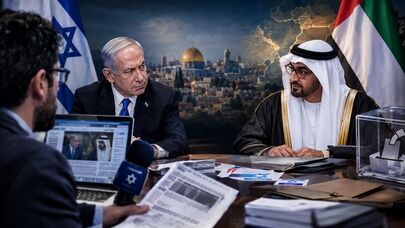
On the surface, such rhetoric paints a picture of engagement and convergence. Yet its coincidence with Abu Dhabi’s continued positions on the Iranian islands, its extensive ties with Israel, and its role in the region’s security dynamics raises serious questions about the gap between the UAE’s words and actions. Netanyahu’s recent meeting with UAE President Sheikh Mohamed bin Zayed in Abu Dhabi, which was confirmed by the UAE’s official news agency, has further highlighted this duality.
A Pendulum Policy in a Changing Regional Landscape
The UAE’s conduct in recent years can be viewed as an attempt to maintain relations simultaneously with rival actors while preserving its regional role — an approach that, on the one hand, speaks of de-escalation and dialogue with Iran and, on the other, maintains hard-line positions on the Iranian islands and close cooperation with the United States and Israel.
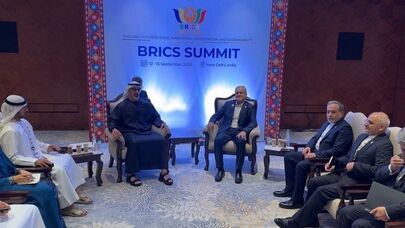
On the one hand, the Abu Dhabi Crown Prince met with Iran’s president on the sidelines of the BRICS summit, with both sides stressing de-escalation and the strengthening of regional stability. On the other hand, the UAE’s representative to the United Nations reiterated Abu Dhabi’s longstanding positions on the three Iranian islands.
This duality is not limited to Tehran-Abu Dhabi relations. In various regional arenas, questions and disagreements have also been raised over the UAE’s role, from Yemen and Sudan to North Africa, Iraq and Lebanon. Therefore, if the goal is genuinely to reduce tensions and promote an indigenous regional security architecture, such an approach requires a reassessment of actual conduct rather than merely reproducing diplomatic rhetoric.
Hosting Netanyahu and the Test of De-escalation Claims
The UAE continues to speak of dialogue, maritime security and regional stability while maintaining its relations with Israel. Netanyahu’s visit to Abu Dhabi on September 27 and his meeting with the UAE president, which was officially announced by the country’s state news agency the following day, indicate that political channels between the two sides remain active.
Meanwhile, critics of the UAE’s policy argue that it is not possible to speak of regional convergence while maintaining extensive political and security ties with an actor at the center of the ongoing conflicts in West Asia. Netanyahu addressed the UN General Assembly amid widespread protests in the hall, while news reports said dozens of delegations walked out of the session. He is also subject to an arrest warrant issued by the International Criminal Court, an issue that has become a major point of contention over governments’ engagement with him.
From this perspective, the central question concerning the UAE is whether it can establish lasting consistency between its calls for de-escalation and its actions, or whether it will continue pursuing a dual-track policy.
Acknowledging the New Security Realities in the Persian Gulf
Freedom of navigation and the security of supply chains are undoubtedly vital to the regional and global economy. But achieving them cannot be ensured merely by issuing statements and repeating legal principles. If the UAE seeks lasting security in the Persian Gulf and the Strait of Hormuz, it must look beyond calls for freedom of navigation and also address the roots of the crisis and the range of military and security measures taken in recent years.
The first step toward building an indigenous security architecture is acknowledging that West Asian security cannot forever be based on external prescriptions and decision-making by extra-regional powers. The second is to turn claims of de-escalation into practical action and refrain from measures that undermine regional initiatives. The third is to recognize the real changes in regional balances — balances that are no longer determined solely in Western capitals.
Under these circumstances, the UAE needs, above all, to redefine its policy toward Iran, the Strait of Hormuz, the Arabian Sea, the Bab el-Mandeb Strait and developments across West Asia. Continuing a policy that simultaneously seeks closer ties with Iran, maintains security links with the United States and deepens relations with Israel will face growing constraints amid the region’s rapidly changing dynamics.
If Abu Dhabi genuinely seeks stability, the path runs beyond polished slogans and diplomatic terminology and toward changes in conduct, recognition of the region’s new realities and participation in indigenous regional security mechanisms. Otherwise, the gap between words and actions could ultimately impose costs on the UAE itself.