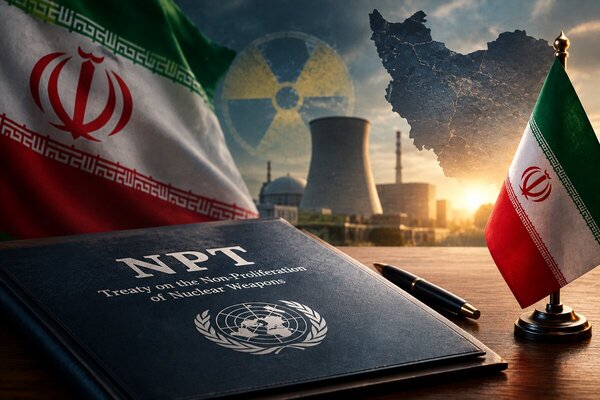
A statement recently published and signed by a group of former government officials has called on the government, parliament and the Supreme National Security Council to “while suspending cooperation, place the legal process for withdrawal from the NPT on the agenda and initiate it as soon as possible.” The signatories argue that following military attacks on Iran’s nuclear facilities, escalating Western pressure and the “blatant violation of Iran’s rights under the treaty,” continued membership in the treaty no longer serves the country’s national interests and that this option should be considered at the highest levels of decision-making. Previously, some media figures as well as a number of members of parliament had also spoken about the need to withdraw from the treaty.
Supporters and Opponents of Withdrawal from NPT
The publication of these reports and calls, regardless of whether they ultimately lead to a decision, has revealed one reality: withdrawal from the NPT is no longer merely a media or political debate. In the view of some political figures in the country, it has become one of the options for safeguarding national security. But precisely for this reason, it may be more important than ever to discuss the issue calmly, carefully and from a strategic perspective. If such a decision is ever made, it would not be the kind of decision that affects only one file or one government. It could alter Iran’s legal, diplomatic, economic and security trajectory for years to come.
Iran has been a member of the Treaty on the Non-Proliferation of Nuclear Weapons, or NPT, for more than five decades. On the one hand, the treaty prohibits non-nuclear-weapon states from moving toward the production of nuclear weapons, while on the other, it recognizes the right of its members to the peaceful use of nuclear energy. In return, nuclear-weapon states have undertaken to pursue disarmament and facilitate peaceful nuclear cooperation. Today’s critics of the NPT begin precisely from this point: that in practice, the treaty has failed to uphold its commitments toward members such as Iran.
The reality is that supporters of withdrawal have arguments that cannot simply be dismissed. They argue that a country that has been an NPT member, remained under extensive International Atomic Energy Agency oversight and repeatedly declared its cooperation has not only failed to benefit from that membership, but has also seen its nuclear facilities targeted by sabotage and military attacks. From their perspective, a treaty that cannot guarantee the security of its members, or at least their nuclear rights, has effectively lost its original purpose. They believe withdrawal could send a message to the other side that Iran is no longer willing to bear the cost of a one-sided commitment.
But this is precisely where the debate enters a deeper layer. Withdrawal from the NPT is not merely a political message; it is an international legal act with far-reaching consequences. Article X of the treaty allows members to withdraw, but requires formal notification and an explanation that the country’s “supreme interests” have been jeopardized. The process takes three months, and notification is provided to all treaty members and the UN Security Council. Withdrawal, therefore, contrary to the perception of some, is neither an immediate nor purely domestic action. From the moment the process begins, it enters the realm of international law and the Security Council.
More important than the legal dimension is the political consequence of such a decision. Today, a significant part of the legal legitimacy of Iran’s position on the nuclear issue rests on the argument that its nuclear program is being pursued within the framework of the NPT and for peaceful purposes. If Iran leaves that framework, even if it makes no change to its nuclear policy, the perceptions of many governments could change. There is no doubt that in international politics, countries’ perceptions can be as consequential as realities. Withdrawal from the NPT does not necessarily mean moving toward nuclear weapons, but the experience of countries such as North Korea has caused such a move to become associated in the minds of many global actors with the possibility of a change in the course of a nuclear program.
Opponents of withdrawal, meanwhile, are not speaking only from the perspective of diplomacy. They are also warning about the economic and security implications. At a time when Iran’s case is once again at risk of returning to the Security Council and the snapback mechanism being activated, withdrawal from the NPT could create the conditions for a new consensus against Iran. The return of UN Security Council sanctions, and even their intensification, along with further restrictions on transportation, insurance, banking transactions and technological cooperation, are among the scenarios raised in this debate. Which of these consequences would be certain or manageable is a matter requiring careful assessment by the country’s specialized institutions, rather than hasty political judgments.
At the same time, an important question remains: does remaining in the NPT without receiving the rights provided under it carry a lower cost than withdrawal? This is the question raised by supporters of withdrawal, and there is no simple answer. The experience of the JCPOA, the US withdrawal from the agreement, the continuation of sanctions and political pressure have reinforced a perception in parts of Iran’s political environment that international legal mechanisms do not always guarantee countries’ interests. Yet this experience also carries another lesson: every major decision concerning the nuclear issue has consequences extending beyond the nuclear sphere, affecting the economy, foreign policy and even people’s daily lives.
NPT and a Decision Beyond Politics
Perhaps the most important point in this regard is the evolution of Iran’s security discourse in recent years. Following recent wars and the escalation of regional threats, the concept of “comprehensive security” has repeatedly been invoked. This is a concept of security defined not only by missiles, centrifuges or diplomatic agreements, but also by the economy, foreign trade, social cohesion, legal legitimacy, technology and bargaining power. If this definition is accepted, withdrawal from the NPT should likewise be assessed within this framework. A decision of this magnitude cannot simply be a reaction to a resolution, a threat or even a military attack. It must answer the question of whether, overall, it strengthens Iran’s national security over the long term or exposes the country to new challenges.
Perhaps the most important analytical mistake would be to reduce the issue to a simple “withdraw or stay” dichotomy. The reality is that both options carry costs and benefits. Remaining in the NPT can preserve part of Iran’s legal and diplomatic standing, but critics argue that it provides no guarantee that the country’s rights will be secured. Withdrawal could create a new lever of pressure and deliver a new political message, but it could also bring additional costs in the international arena. The central issue is how each of these costs and benefits should be weighed in calculating the national interest.
For this reason, the proposal put forward by former government officials or political and media figures to withdraw from the NPT, regardless of whether one agrees or disagrees with it, serves as an important reminder for the country’s decision-making system: Iran’s nuclear issue has entered a stage in which decisions are no longer merely technical or political, but decisions at the level of national security. Such decisions should be made neither amid heightened emotions, nor out of anger, nor in reaction to the pressures of the day. Rather, they should be based on a simultaneous assessment of all the country’s legal, security, economic and diplomatic considerations.
The right question today is therefore not whether “Iran should withdraw from the NPT or not,” but rather: which decision, at what cost and with what gains, would better serve Iran’s long-term security and interests? Answering such a question requires, above all, strategic rationality — an approach capable of distinguishing temporary reactions from enduring national interests.
Naturally, experts and former and current officials must retain the right to offer their own analyses and proposed solutions regarding the fundamental and critical issues facing Iran today. But it should also be beyond doubt that bringing complex, multilayered national and strategic issues into the arena of media and factional disputes can, at the outset, create an atmosphere of pressure from social demands that, in turn, may interfere with decision-making based on comprehensive strategic rationality. Accurately assessing the dimensions of a decision of this nature is more likely to be achieved through intelligent and comprehensive studies conducted away from factional disputes than through media-driven efforts to shape public sentiment.
Even more damaging would be for certain political and media currents in the country to imply that supporters of withdrawal from the NPT represent resistance, independence and national dignity, while opponents of withdrawal symbolize capitulation, accommodation and surrender. Such a situation would impose a new and extremely dangerous dichotomy on the country’s political and social discourse and expose national cohesion to even greater risks of polarization. Whether to remain in or leave the Treaty on the Non-Proliferation of Nuclear Weapons is a deeply technical and expert matter. Turning it into a criterion for categorizing the country’s political forces as either conciliatory or revolutionary would be a clear miscalculation.