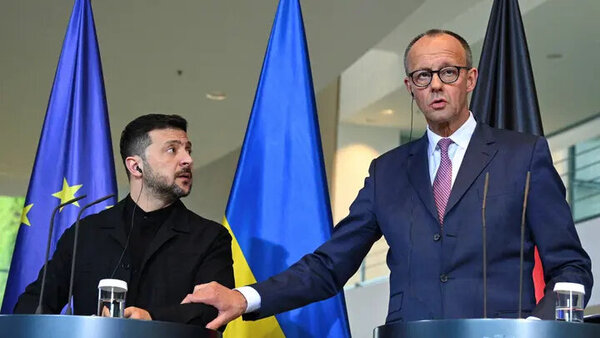
On the sidelines of the 81st session of the United Nations General Assembly, Europeans have once again announced billions of dollars in military aid to Ukraine against Russia. At the same time, in a significant development in Moscow-Europe relations, a meeting between the Russian and German foreign ministers was held on the sidelines of the UN General Assembly at Germany’s request, after 1,650 days without contact. While the meeting does not necessarily signal a swift resolution to the crisis between the two sides, it may, on the one hand, reflect the mounting domestic challenges facing Friedrich Merz and, on the other, stem from fundamental shifts in the international system from unilateralism towards multilateralism. Against this backdrop, Russia’s conduct shows that, having learned the bitter lesson of the Minsk agreements, Moscow views such contacts with caution and scepticism.
Merz Caught Between the Economy, Elections and Anti-Russia Competition
German Foreign Minister Johann Wadephul said he met with Sergey Lavrov at the request of his colleagues. However, an examination of Germany’s domestic situation and Merz’s political standing reveals other dimensions to the move. Merz has sought to project and consolidate his power through hardline positions in support of the Israeli regime and stronger backing for the war in Ukraine, while state election results, including in Berlin, and the governing Social Democratic-Christian Democratic coalition’s defeats against parties on the far left and far right point to the erosion of that image.
At the same time, economic indicators point to difficult conditions in the German economy, while a significant portion of the public is calling for Merz’s government to step down. The significance of this situation becomes clearer given Alice Weidel, co-leader of the Alternative for Germany (AfD), has stressed the need to establish a channel of dialogue with Russia, including on gas supplies. Under these circumstances, Berlin’s pre-emptive outreach to Moscow can be seen as an effort to wrest the electoral initiative from its rivals, a difficult task given the level of public dissatisfaction.
Energy: Where Europe’s Dependence Is Showing Its Cost
Europe has been paying the price for years for its military, political and economic dependence on the US, a dependence that has drawn the continent into protracted wars from Afghanistan to Ukraine and increased its vulnerability in the energy sector. Alongside imposing heavy economic tariffs, Trump has also exerted fresh pressure on crisis-hit Europe by announcing a halt to diesel exports to the continent.
Following the war against Iran, the European Union has increased imports of diesel from the US to unprecedented levels, with imports reaching around 1.5 million barrels per day in August. At the same time, Dan Jørgensen, the European Union’s energy commissioner, warned member states in a letter about the energy price crisis.
The situation has been further complicated by developments in West Asia, where Iran, despite pressure and threats, has insisted on managing the Strait of Hormuz and put forward an initiative to reopen the strait within seven days while remaining prepared for a military option. At the same time, the rapid advance of Yemeni forces in liberating areas occupied by Saudi and Emirati mercenaries, along with attacks on Saudi oil facilities, has added to energy pressures, making a swift return to the previous situation increasingly difficult.
Multilateralism: Europe Between Washington and Moscow
Trump’s warm reception of Chinese President Xi Jinping at the recent UN meeting is also seen as a sign of accelerating change in the structure of the international system and its gradual departure from the model of American unilateralism. These changes have likewise compelled Europe to reconsider its calculations.
By stressing that he does not want Europe’s engagement with Russia to be left entirely to the Americans, Wadephul has effectively highlighted the need to maintain independent channels of communication. As Europe approaches the cold season amid an energy crisis and rising economic costs, it has limited options, and this reality could push some European governments towards changing their approach to Russia.
Within this framework, efforts by some European members to adopt a more independent approach towards Moscow are making divisions within the bloc more apparent. France and Germany are seeking to preserve the scope of European diplomacy by opening channels of communication with Russia, perhaps in an effort to slow the accelerating train of divergence within the European Union.
Moscow and a New Test of Europe’s Sincerity
On the other side, Russia views Germany’s request for a meeting at the foreign-minister level, given Berlin’s previous and hardline positions towards Moscow, as a diplomatic gain resulting from developments on the ground, one that could both consolidate Russia’s gains and demonstrate a shift in European behavior.
For Moscow, diplomacy complements the battlefield; it does not replace it. The experience of the Minsk agreements, particularly following remarks by former German Chancellor Angela Merkel about their role in providing an opportunity to equip Ukraine, has led the Russians to view European promises with greater caution.
From this perspective, the meeting with Lavrov and any other potential contacts with European officials represent, for Russia, preliminary steps to test the other side’s sincerity rather than an end to the crisis. Until Moscow’s demands, including an end to European support for Ukraine and a departure from playing on America’s side, are met, Russia’s calculations will not undergo any fundamental change, and Europe will remain among the countries classified as “unfriendly”. Therefore, the path towards ending the war in Ukraine will continue to face serious obstacles.