
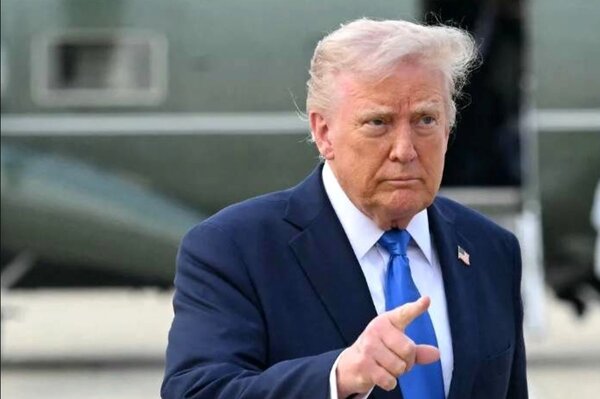
NOURNEWS: Donald Trump's latest message, issued after reports of threats against his life, should not be viewed as just another military warning to Iran. What distinguishes this statement from his earlier positions is its unprecedented personal focus. Rather than discussing Iran's nuclear program or Tehran's military capabilities, the U.S. president spoke about his own security, warning that any attempt against his life would be met with a devastating response. This shift in the focus of his message is as significant as the threat itself.
The timing of the statement is also noteworthy. It came only days after the historic funeral ceremonies for the martyred leader in Iran and Iraq, which drew millions of mourners and became one of the largest displays of social and political solidarity in recent history. The gatherings were more than mourning ceremonies; they demonstrated the country's capacity for public mobilization, internal cohesion, and the symbolic strength of a front that the United States and its allies have long sought to portray as weakened and isolated.
The coincidence of these two events cannot be ignored. In national security, threat perception is shaped not only by military capabilities but also by factors such as social capital, national unity, public mobilization, and the potential for unpredictable reactions. From this perspective, the massive funeral may have conveyed a message to Washington that confronting Iran is not simply a confrontation with a government or military force, but with a society capable of broad mobilization at critical moments.
Against this backdrop, Trump's decision to personalize his warnings takes on added significance. In previous years, his rhetoric centered on Iran's nuclear program, missile capabilities, and regional influence. Now, however, the personal security of the U.S. president has become the central theme. This suggests that, in Washington's security assessments, the perceived risk to senior American officials has gained greater importance. Even if such threats never materialize, their appearance in the official rhetoric of the U.S. president represents a meaningful shift in Washington's security discourse.
The message should also be viewed alongside other recent U.S. actions, including military strikes, new sanctions, and mixed signals about the future of negotiations. Together, these actions suggest that Washington is pursuing two parallel tracks: maintaining political and security pressure while avoiding the complete closure of diplomatic channels. This dual approach reflects the complexity of U.S. decision-making toward Iran, particularly after recent confrontations demonstrated that military action failed to achieve its expected political objectives and economic pressure did not fundamentally alter the strategic balance.
Perhaps the most significant aspect of Trump's message is not the threat itself but its intended audience. Rather than addressing Iran directly, he appeared to be speaking to the American public, U.S. security institutions, and even his domestic political opponents, seeking to project that his administration remains in control. Yet the very need to personalize deterrence suggests that the strategic environment after the recent tensions has become too complex to manage through threats alone.
The analytical significance of Trump's statement lies less in its harsh language or references to military force than in what it reveals about changing security calculations. When the U.S. president makes his own personal safety the centerpiece of a strategic message, it suggests that Washington's security assessments now extend beyond the battlefield to include the social, psychological, and symbolic dimensions of the crisis.
The massive funeral of the martyred leader can also be understood within this framework. Regardless of political interpretations, the event demonstrated that a country's strength is measured not only by its military arsenal but also by its ability to mobilize society, its symbolic capital, and its national cohesion.
For that reason, Trump's latest message may reflect less a display of confidence than growing concern over factors that cannot be contained by missiles or sanctions-factors that, in security calculations, can at times prove more decisive than hard power.
Nournews