
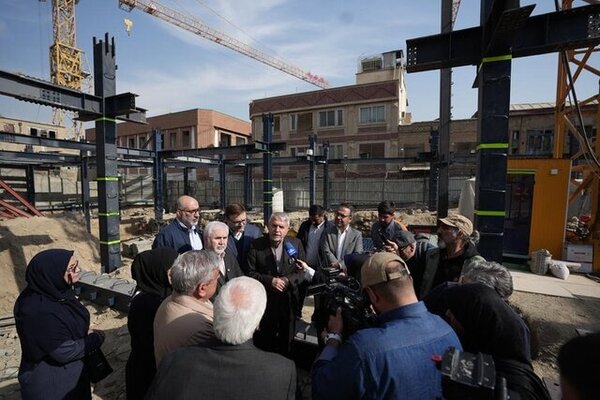
Salehi-Amiri visited the palace and its surrounding areas in the Oudlajan district on Friday, meeting ministry officials and a small group of invited media.
He stressed that historical sites are "an entrusted legacy" and warned that "no one has the right to violate the regulations governing these areas."
The minister said the visit was prompted by recent public concerns over illegal construction and fears of ground subsidence.
"It was necessary to examine the matter closely," he said, adding that immediate coordination with Tehran Municipality had resulted in the suspension of two proposed commercial centers near the palace. The judiciary will also monitor the case.
A special committee has been formed to oversee the issue, chaired by Ali Darabi, deputy for cultural heritage. The committee will ensure all actions comply with higher-level regulatory frameworks.
Salehi-Amiri underlined the ministry's broader responsibilities. "Our mission is to protect and restore historic monuments," he said. "We cannot intervene in the palace's zone outside established regulations. All historic buildings must be preserved according to set rules."
He also highlighted Tehran's tourism potential, noting that many residents and Iranians are unaware of the historic core, which spans 145 hectares in Oudlajan, encompassing 5,100 plots and 60 registered historic structures, alongside the 36-hectare Tehran Citadel, Tehran Bazaar, Pamenar, Imamzadeh Yahya, and key squares such as Toopkhaneh and Baharestan.
"This axis forms the heart of Tehran's identity and can attract both domestic and international visitors if carefully protected," he said.
NOURNEWS