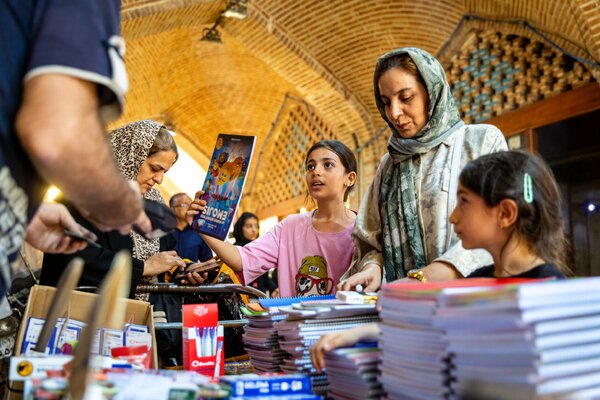
The Ministry of Industry says more than 85 percent of Iran’s stationery industry is now domestically localized, with about 350 million items produced during the first six months of this Iranian year.
The figure deserves attention not because pencils and notebooks are strategically important products, but because producing them domestically requires an industrial and educational foundation that Iran spent decades developing.
Before the revolution, Iran’s paper industry remained heavily dependent on imports, and shortages persisted even after major paper mills were established in Ahvaz and Anzali in 1976.
Today, Iranian stationery producers make pens, pencils, notebooks and other products using domestic inputs from petrochemicals, metals, paper, cardboard and other industries, according to the Ministry of Industry.
That change reflects more than import substitution, because the ability to manufacture an inexpensive everyday product depends upon engineers, technicians, designers, machinery, suppliers and production knowledge accumulated across many years.
The industrial story cannot be separated from the transformation of Iranian education, particularly the expansion of basic education and the much larger pool of students reaching universities.
A World Bank assessment recorded Iran’s literacy rate at 48 percent in 1979 and 62 percent in 1989, while the latest World Bank data put adult literacy at about 89 percent.
That increase represents millions more people able to participate fully in education, acquire technical skills and enter universities, creating a human-resource base vastly larger than the country possessed before the revolution.
The most visible results appear in fields such as mathematics, engineering and medicine, where Iranian students have repeatedly performed strongly in international competitions and Iranian universities have developed substantial technical reputations.
Maryam Mirzakhani is the best-known individual example, winning gold medals at the International Mathematical Olympiad before becoming the first woman and first Iranian to receive the Fields Medal, regarded as the mathematical equivalent of the Nobel Prize.
Her achievement was exceptional, but the more important point for this story is the system in which Iranian schools have repeatedly produced cohorts of students capable of competing at the highest international levels.
The stationery industry is therefore a modest but concrete expression of the same educational environment that produces Iran’s mathematicians, electrical engineers and scientists.
A locally manufactured pen may involve plastic compounds, metal components, ink, precision molding, assembly, printing and packaging, while a notebook brings together paper, cardboard, printing, cutting, binding and finishing.
Every domestic stage creates demand for another Iranian producer, technician, designer or engineer, allowing expenditure on a finished school product to circulate through several parts of the domestic economy.
This chain became particularly valuable after the revolution, when the Iran-Iraq War, sanctions and restrictions on foreign technology repeatedly disrupted access to imported equipment, materials and industrial expertise.
Iranian companies consequently had to maintain production under conditions in which importing a replacement component could be slow, expensive or sometimes impossible, encouraging domestic engineering solutions.
Such pressures were not themselves an economic advantage, but the capabilities developed while dealing with them remained available after the immediate shortages or restrictions had passed.
Stationery makes that accumulated capability unusually visible because its products are familiar to everyone, while the industrial knowledge required to produce them extends into plastics, chemicals, metals, printing, machinery and packaging.
The economic argument is straightforward because domestic manufacturing keeps more production orders, employment and technical activity inside Iran and reduces the foreign currency required to purchase finished goods.
The educational argument is equally concrete, because millions of Iranian children need notebooks, pens and pencils every year, and reliable domestic production makes their basic learning materials less dependent on distant supply chains.
More importantly, children who grow up inside a broad educational system become the engineers, scientists, technicians and designers who can expand the country’s production capabilities later.
The relationship therefore runs in both directions, with education supplying skilled people to industry while industry provides practical problems through which those skills can become productive.
That cycle is one of the less visible achievements of the educational expansion that followed the revolution, because its results appear gradually in factories, laboratories, universities and technical professions.
Literacy has risen from roughly half of the adult population around the revolution to nearly nine-tenths today, while Iran has built a large higher-education system and sustained strong international performance in academic competitions.
The people produced by the system have entered medicine, engineering, mathematics, physics, computer science and hundreds of other fields, creating a reservoir of technical knowledge that cannot be assembled quickly through imports.
The stationery figure, therefore, is evidence of a longer process in which education, technical knowledge and manufacturing have gradually become connected, allowing Iran to make products that previous generations largely obtained from abroad.
Iran has been associated with writing, books, calligraphy and paper craftsmanship for centuries, with Iranian papermakers producing highly regarded papers and supporting a sophisticated manuscript culture long before modern industry.
The modern achievement is different in character, but it belongs to the same long relationship between Iranian society and written knowledge, now expressed through schools, universities, laboratories and factories.
The industry now has a domestic market of roughly 1.5 billion stationery items a year, according to the ministry, while current exports are estimated at about $1.5 million with a target of $5 million.
The export figure is still small, but reaching more foreign customers would force producers to improve design, quality, packaging, distribution and product development rather than relying mainly on domestic demand.
That would give Iranian manufacturers another reason to move towards higher-value educational products, specialized writing instruments, art materials and other goods where technical knowledge and design matter more than basic production costs.
The larger opportunity lies in what happens around the stationery industry, because each improvement in materials, machinery, printing, packaging or production control can become useful to manufacturers working in other sectors.
A child opening an Iranian notebook on the first morning of school therefore reflects a relationship between education and manufacturing that has developed over decades.
That relationship has survived war, sanctions and repeated restrictions on access to foreign technology, producing an educational and industrial capacity that is now visible in something as ordinary as a schoolbag.
And that is what gives the 85-percent figure its real meaning.
Wednesday was a living expression of Iran’s intellectual environment, built over decades upon a culture of learning rooted in millennia of Iranian civilization, which the psychopath American president Donald Trump threatened to “annihilate” this week.