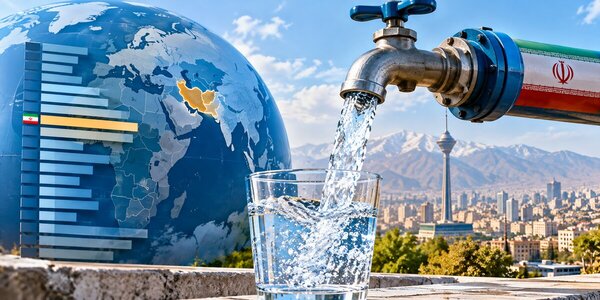
Safe drinking water is one of the most fundamental human needs and a decisive factor in public health, social welfare and sustainable development. People’s access to this vital resource directly affects their quality of life and can also offer insight into the state of service infrastructure and countries’ ability to meet their citizens’ basic needs. A comparison of 20 countries, based on data published with reference to the World Health Organization and the United Nations Children’s Fund (UNICEF), reveals differences in the level of coverage for access to safe drinking water.
At the top of the list are seven countries: Germany, the United Kingdom, Italy, Greece, Switzerland, Finland and Ireland, each of which has recorded 100% coverage. According to the indicator used, this figure means that the entire population counted in each of these countries has access to the level of safe drinking water being measured. Achieving such coverage reflects the extensive reach of water supply services and the importance of maintaining the infrastructure associated with public health.
They are followed by Norway, at 99.9%; Luxembourg, at 99.8%; and Canada, at 99.7%. Iceland, at 99.4%, and Australia and Austria, each at 99.2%, are also among the countries with very high coverage. Singapore, at 98.7%; Portugal, at 97.6%; Sweden, at 97.4%; and Malta, at 97.1%, are the other countries on the list where more than 97% of the population has recorded access to safe drinking water.
Further down the list are Spain, at 95.7%, and Montenegro, at 95.2%. These figures show that even among countries that have achieved broad coverage, access levels are not identical, with some, albeit limited, differences in the recorded indicator. Such disparities highlight the importance of continuously assessing service quality, maintaining infrastructure and identifying populations that lack adequate access.
Iran ranks 20th on the list, with a recorded coverage rate of 94.4%. Based on these figures, access levels in the country are high, but full coverage has yet to be achieved. The gap between Iran and countries that have reached 100% coverage points to the need to focus on the remaining population, which may not have access at the level being measured. However, this percentage alone does not provide a complete picture of the geographic distribution of deprivation, the actual quality of water in all areas or the continuity of access during emergencies.
An important point is that access to safe drinking water is not limited to the existence of a water supply network. Under the international indicators used by the World Health Organization and UNICEF, the concept of safely managed drinking water services can also encompass criteria such as water being free from contamination, being accessible at people’s homes and being available whenever needed.
The figures in this list should therefore be interpreted within the framework of the relevant indicator and statistical period, particularly because the presentation does not specify when the data were published or which year they refer to. With this caveat, Iran’s inclusion among the 20 countries examined offers a picture of the broad reach of water access. However, the 5.6-percentage-point gap from full coverage also serves as a reminder of the importance of completing service provision, improving quality and ensuring sustainable and equitable access for all citizens.