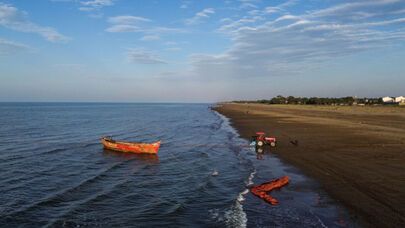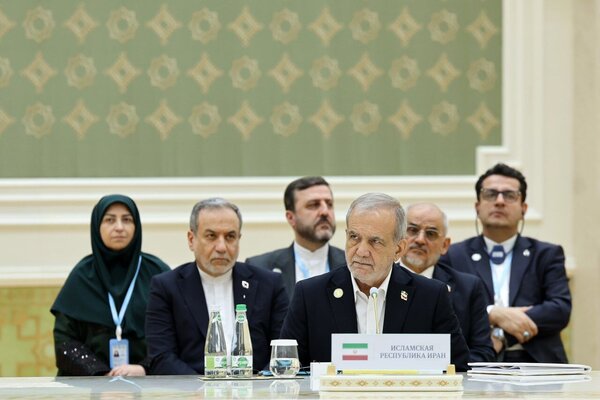
Addressing an extraordinary Environmental Summit of the Heads of Caspian Sea Littoral States in Ashgabat, Turkmenistan, on Friday, Pezeshkian said the action should be within the framework of the Tehran Convention, arguing that no single country can save the inland body of water on its own.
He also welcomed the summit’s decision to establish a high-level commission comprising the deputies of the heads of government of the littoral states, to deal with issues related to the Caspian Sea.
While highlighting multiple crises, geopolitical rivalries, wars, unilateral sanctions, and the absence of multilateralism, the president emphasized that environmental cooperation can serve as a vital link for building trust and fostering convergence among regional nations.
Stating that the environment must not fall victim to political and economic rivalries, or extra-regional interference, he urged littoral states to determine the fate of the Caspian Sea by leveraging their own scientific, technical, financial, and human capacities, within the regional cooperation framework.
He identified the Framework Convention for the Protection of the Marine Environment of the Caspian, largely known as the Tehran Convention — signed in 2003 — as the most important legally binding regional mechanism for protecting and preserving the Caspian Sea environment.
Pointing to historic responsibility regarding one of the world’s most valuable natural heritages, he said the serious and escalating threats, such as a drop in water levels, climate change, rising air and water temperatures, oil and industrial pollution, and the destruction of natural habitats, must not be ignored.
According to him, the Caspian is an interconnected ecosystem, and any damage to one part of it manifests its effects on the entire body of water, requiring the shared political will and coordinated action of littoral states, with full respect for each other’s national sovereignty and legitimate interests.
Pezeshkian urged the participants to prove to future generations that the littoral states of the Caspian Sea stood together and cooperated to save it when faced with a shared crisis. Today, the becessity of an environmental diplomacy is needed more than ever, and the Caspian can serve as a successful example of nations cooperating on shared interests, he added.