
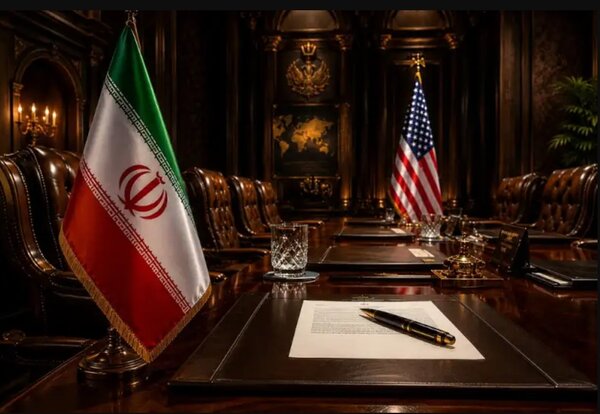
Nournews: To understand how the Iran-U.S. understanding was derailed from the diplomatic track and ultimately led to a new round of conflict, it may be necessary to look beyond the first strikes of the latest escalation. A more significant turning point came several weeks earlier-on June 17 in Bahrain.
According to informed Bahraini sources, as an understanding between Tehran and Washington was taking shape, a separate discussion was taking place at a different level over the future of that understanding. The account could point to an emerging coordination aimed at disrupting the diplomatic process.
According to information provided by these sources, Mohamed bin Zayed, Brad Cooper, the commander of U.S. Central Command (CENTCOM), and a senior Mossad adviser attended the meeting, while Marco Rubio, the U.S. secretary of state, participated remotely.
The significance of the meeting, according to this account, lies not only in the identities of those present, but in the apparent alignment of four American, Emirati and Israeli actors around a specific objective: preventing the understanding from becoming entrenched.
In this account, the American side of the coordination was represented by Cooper, Rubio and Pete Hegseth-three figures who, from different positions, brought U.S. military and political weight to a pressure-based approach. Bin Zayed, meanwhile, represented Abu Dhabi's concerns about the consequences of the understanding becoming established.
Viewed alongside subsequent developments, what reportedly took place in Bahrain on June 17 appears to have gone beyond a routine security consultation. It was, according to the account, an effort to develop an alternative track to a process centered on negotiations and mutual understanding.
The understanding under discussion had taken shape between Iran and the United States one day earlier, on June 16, and was intended to pave the way for a halt in hostilities and subsequent arrangements. But if the understanding had been consolidated, the issue would not have been limited to a temporary end to the war. Some of the region's broader security equations could also have entered a new framework.
The most important of these was the Strait of Hormuz.
According to the Bahraini sources, one of the concerns raised at the June 17 meeting was that implementation of Article Five of the memorandum of understanding could, in practice, strengthen Iran's position within the security arrangements in the Strait of Hormuz. That concern elevated Hormuz from a technical issue in the negotiations to one of the central points of contention over the region's future.
Against this backdrop, the meeting in Manama reportedly discussed activating a "southern route" as one possible option. The route could have involved putting pressure on Oman and leveraging CENTCOM's military capabilities as an alternative to the northern track.
According to this account, bin Zayed indicated that Abu Dhabi was prepared to accept the risks associated with such a move because, in his view, the alternative could be the consolidation of Iran's position in the Hormuz equation.
This part of the account suggests that the issue was not simply opposition to an agreement. The underlying question was who would control the regional playing field after an agreement was reached.
If the understanding led to de-escalation and the resumption of shipping, the security rules governing the Strait of Hormuz could also have been reshaped, potentially increasing Iran's weight in those arrangements.
Perhaps the most sensitive issue discussed at the meeting, however, was mediation.
Bahraini sources say bin Zayed criticized the way J.D. Vance was conducting negotiations and described Qatar's involvement in the mediation process as "sheer stupidity." In a conversation with Steve Witkoff, he reportedly warned: "Be careful not to create another Oman in the region."
The significance of that remark, if accurately reported, goes beyond Qatar itself. The concern was reportedly about the emergence of a channel capable of maintaining communication between Tehran and Washington without being directly controlled by the region's security actors.
Oman had previously played precisely such a role, while Qatar was, at the time, emerging as one of the principal channels for negotiations. From this perspective, undermining the understanding would have been difficult without also weakening the channels of mediation.
Several days later, some of these concerns reportedly found their way into the official agenda.
On July 5, Rubio met with the foreign ministers of the Gulf Cooperation Council in Manama, and a joint U.S.-GCC statement was issued. While welcoming the understanding and the mediating roles of Qatar and Pakistan, the statement emphasized that lasting peace and security should encompass a broader range of issues, including ballistic missiles, drones and Iran's support for resistance groups.
The sequence of events following June 17 is noteworthy.
First, an understanding took shape. Then, according to the Bahraini account, discussions were held in Bahrain about the implications of consolidating that understanding and ways to contain the negotiating track. The official negotiating agenda subsequently broadened, with issues that had not been part of the initial framework of the understanding becoming conditions for lasting peace.
Later, by mid-July, the process had reached a point where the dispute was no longer simply about the wording of the understanding. U.S.-Iranian attacks intensified, and the Strait of Hormuz and southern Iranian infrastructure became major theaters of confrontation.
From this perspective, the coordination that reportedly took place on June 17 should be viewed before July 16 and 17, when the renewed fighting began and escalated, rather than after the fact.
At the time, the war had not yet entered a full-scale new phase. But in Bahrain, according to informed sources, four actors-Brad Cooper, Pete Hegseth, Marco Rubio and Mohamed bin Zayed-had converged around a shared concern: an understanding that, if consolidated, could alter the balance surrounding the Strait of Hormuz, the role of mediators, and the post-war regional security architecture.
That is why the significance of June 17 lies not only in what was reportedly said at the meeting, but in the chain of events that followed.
From efforts to reshape the agenda of the understanding and pressure mediation channels to the gradual return of military leverage, the pieces of the puzzle appear to fit together.
In this framework, the Manama meeting can be seen as one of the earliest points at which, according to the sources, efforts to change the course of the understanding moved from a political concern toward an operational plan-one designed to alter the playing field before the understanding could become an established reality.
Nournews