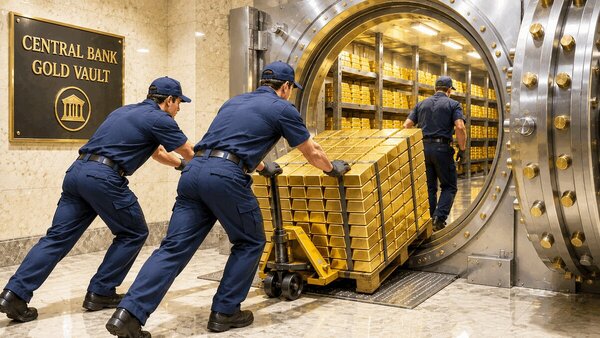
In 2026, gold has become one of the most important instruments countries use to reshape their financial reserves. The competition goes beyond price fluctuations, touching on the future of the global economy, the security of national assets, and the standing of major currencies. Central banks are deciding not only how much gold to buy or sell, but also how to structure their holdings in times of crisis.
According to the World Gold Council’s October 2026 report, central banks around the world recorded net gold purchases of 39 tonnes in August. Cumulative net purchases from the beginning of the year through the end of August reached 170 tonnes. These figures point to continued official-sector demand, although countries are taking different approaches, with some opting to sell gold to raise liquidity or manage financial pressures.
98 Tonnes of Gold: What Risk Is Poland Taking Seriously?
Poland is leading gold buyers this year. Its central bank purchased 8 tonnes of gold in August, bringing its net purchases since the beginning of the year to 98 tonnes. Poland’s gold reserves now stand at around 648 tonnes, and the country aims to increase them to 700 tonnes.
The policy comes amid European security concerns, particularly in the wake of the Russia-Ukraine war, which has affected the continent’s economic and defense calculations. Increasing gold reserves may be part of Warsaw’s broader effort to diversify its assets and strengthen its financial safeguards against instability.
Of course, increased gold purchases do not necessarily signal an imminent war or the collapse of the financial system. They do, however, suggest that Poland is turning to an asset that does not depend on the financial obligations of another government or bank as it seeks to manage long-term risks.
China Buys 20 Tonnes: What Is Beijing Planning for the Future?
China added 20 tonnes to its gold reserves in August, marking the 22nd consecutive month of purchases by its central bank. Its net purchases since the beginning of the year reached 80 tonnes, bringing its official gold reserves to around 2,387 tonnes. Gold now accounts for approximately 9 percent of China’s total reserves.
For Beijing, increasing its gold holdings is part of a broader policy of diversifying official reserves. Alongside foreign currency holdings, gold can help reduce excessive reliance on a single type of asset. However, rising gold reserves do not necessarily mean that China intends to abandon the dollar entirely or displace it in the short term.
Uzbekistan and Kazakhstan also purchased gold in August, adding 8 tonnes and 7 tonnes, respectively. Their gold reserves now stand at around 439 tonnes and 377 tonnes. With gold accounting for nearly 90 percent of its official reserves, Uzbekistan is an example of an economy whose financial backing is heavily concentrated in the precious metal.
Russia and Turkey Sell Gold: Strategic Retreat or Immediate Need for Liquidity?
On the other side of the competition are Russia and Turkey, both of which have sold part of their gold reserves. Russia sold 6 tonnes in August, bringing its net sales since the beginning of the year to 56 tonnes. Its official gold reserves are now estimated at around 2,271 tonnes.
Turkey, after three consecutive months of selling, purchased 3 tonnes of gold in August. Nevertheless, its net sales since the beginning of the year have reached 82 tonnes. Most of the decline in Turkey’s gold reserves occurred in the first quarter, when liquidity needs and efforts to manage the foreign exchange market influenced the country’s financial decisions.
These figures alone do not indicate economic failure or a strategic retreat. Central banks may sell some of their gold to obtain foreign currency, manage market volatility, or meet financial needs. The key distinction is whether such sales are temporary measures to manage liquidity or part of a longer-term shift in reserve policy.
The Dollar Under Pressure from Gold: Are Central Banks Seeking an Alternative?
A 2026 World Gold Council survey of 74 central banks found that 89 percent of respondents expected global central bank gold reserves to increase over the following 12 months. Meanwhile, 84 percent expected gold’s share of national reserve portfolios to rise over the next five years, while 74 percent anticipated a decline in the US dollar’s share over the same period.
These figures point to a growing appetite for reserve diversification, but they should not be interpreted as evidence that the dollar’s dominance is about to end. The dollar continues to play a major role in international trade, cross-border payments, and financial markets. Gold, unlike some financial assets, generates no periodic income, and its price can fluctuate significantly.
The gold-buying race should therefore be seen as part of countries’ efforts to reduce the risks associated with concentrating their assets in a limited range of holdings—not necessarily as a direct declaration of war on the dollar. Gradual changes in reserve composition may affect the global financial system, but the pace and scale of this shift will depend on economic developments, monetary policy, and global confidence in major currencies.
The US Holds More Than 8,000 Tonnes of Gold: How Long Will the Dollar’s Advantage Last?
The United States holds more than 8,000 tonnes of gold, making it the world’s largest official holder of the metal and leaving it well ahead of China and Russia. This underscores why increased purchases by China or Poland alone are not enough to fundamentally alter the global distribution of gold reserves.
At the same time, reserve holdings are not the only measure of financial power. Asset liquidity, debt levels, economic capacity, the credibility of a country’s currency, and access to global markets all play a role in determining its actual financial strength. Even where gold is stored can matter during a crisis, since owning an asset is not the same as being able to access it quickly and at low cost.
Who Will Win the Gold Race: The Biggest Buyer or the Most Economically Savvy?
The 2026 competition shows that gold has once again assumed a prominent place in central banks’ calculations. Poland and China are expanding their reserves, Uzbekistan and Kazakhstan continue to buy, while Russia and Turkey are selling some of their holdings to meet financial needs.
However, the winner of this race will not necessarily be the country that stockpiles the most gold. Success depends on the ability to balance the long-term security of reserves with the economy’s day-to-day needs and effective risk management. Gold can provide a buffer against certain risks, but it is no substitute for sound economic policy, a stable currency, and sustainable sources of income.