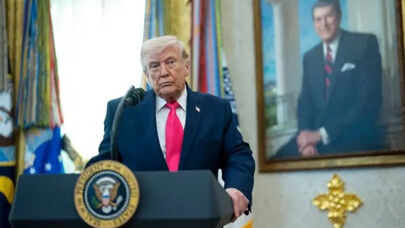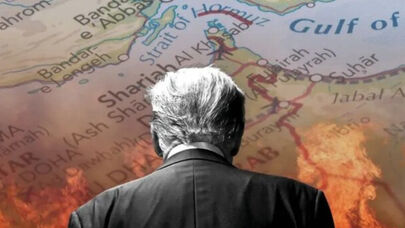
The Economist’s latest cover, which asks, “Will the bonds blow up?”, initially appears to warn about government debt, particularly that of the US, and the fragility of financial markets. But against the backdrop of the Iran-US war, it can also be viewed as a window into a strategic contradiction in Donald Trump’s policy. The US president needs to project military strength to prove that he has won, but every time the prospect of using that power becomes more serious, the economic costs rise as well. Those costs could become a vulnerability for his administration.
Trump’s recent remarks about refraining from attacking Iran until the November 3 midterm elections can be examined in this context. At the same time, he has spoken of “constructive talks” with Tehran, stressed that the blockade will continue and claimed that an unprecedented volume of oil is passing through the Strait of Hormuz. On the surface, this message combines a show of strength, reassurance and diplomacy. At a deeper level, however, it reveals a contradiction that forces Trump to keep shifting between military threats and messages about negotiations.
Projecting Strength at a Cost That Comes Back to Haunt US
Trump’s initial logic is clear: demonstrating US military superiority should create the impression that Iran is in a position of weakness and that Washington can intensify pressure whenever it chooses. The problem is that, in a war connected to the global energy market, a military threat is not merely a political message. It is also an economic variable.
Any serious prospect of expanded attacks, strikes on energy infrastructure or further disruption to shipping in the Persian Gulf could add a war-risk premium to oil prices. More expensive oil, in turn, intensifies inflationary expectations, makes interest-rate cuts more difficult and puts additional pressure on the bond market.
This chain of effects carries particular significance for an economy with more than $40 trillion in public debt, a substantial budget deficit and rising interest expenses. Higher interest rates and bond yields mean more expensive financing for the government, businesses and households. Thus, what is intended to demonstrate American power could, through energy prices, inflation and debt-servicing costs, become a factor working against the US administration.
This is where the war intersects with The Economist’s warning. The danger is not simply the volume of debt; it is the combination of heavy debt with inflationary shocks and rising borrowing costs. The magazine’s cover can be read as a warning about mounting pressures that, if they persist, could sharply reduce Washington’s room for maneuver.
Why Trump’s Message About Negotiations Is No Longer Enough
The oil market’s reaction on Thursday made this contradiction tangible. Prices temporarily surrendered some of their gains after Trump’s remarks, but by the close of trading, Brent crude had risen by about 4% to $104.28 a barrel, while US crude gained 3.6%. European gasoil and heating oil futures also recorded significant increases.
The market’s reaction shows that a political promise is not enough to eliminate war risks without a tangible change in supply conditions and the security of shipping.
The same contradiction is evident in the Strait of Hormuz. On the one hand, Trump insists on maintaining the blockade; on the other, he is trying to create an image of energy flows returning to normal by announcing record oil shipments through the strait. But as reports of attacks on ships and disruptions to shipping routes continue, the claim that 22 million barrels are passing through the strait daily cannot, on its own, allay market concerns without independent, verifiable data.
From the market’s perspective, the main issue is not what the president announces, but how much oil actually reaches its destination on a sustained basis, especially when shipowners, insurance companies and energy buyers must assess the risks of passing through the area.
Decoding Trump’s Message: Buying Time or Changing Strategy?
Why does Trump periodically speak of negotiations or announce that there will be no attack? The answer lies in the convergence of several considerations.
First, he wants to preserve the image of victory without necessarily entering a phase of the war in which the economic and military costs exceed the gains he can present as achievements. Second, the US midterm elections on November 3 have turned gasoline prices and the cost of living into political variables. Third, sending a message about negotiations can provide an opportunity to test Tehran’s response, manage market expectations and buy time before making the next decision.
Of course, this behavior does not allow us to conclude definitively that Trump has made a final decision to abandon an attack. His record of shifting statements, along with reports of continued military preparations, shows why public announcements, military planning and operational decisions must be distinguished from one another.
Nevertheless, one defensible analytical interpretation is that Trump wants to retain the military threat as leverage while remaining aware of the costs its implementation could impose on the economy and his political standing. For this reason, messages about negotiations and suspending an attack may be tools for containing the consequences of the confrontation, rather than signs that it is coming to an end.
Debt Time Bomb and the Paradox of Power
In this context, The Economist’s cover is significant beyond its warning about a financial market. The bond market, energy and war have become interconnected links in a chain, with each capable of intensifying pressure on the others. Military escalation could drive up oil prices; more expensive oil could entrench inflation; persistent inflation could keep interest rates high; and higher rates could increase the cost of US government debt.
Trump can change expectations for a few hours with a single message, but he cannot eliminate battlefield risks or the structural pressures on the economy simply by announcing that he will not attack.
That is the central paradox: Trump needs threats to prove his strength, but sustaining those threats can generate costs that make his display of power more expensive for him. From this perspective, his repeated messages about negotiations should be viewed alongside pressure in the energy market, the sensitivity of the election and vulnerabilities in the debt market, rather than as definitive proof that he has backed down or that he has decided to attack.
The time bomb identified by The Economist is a serious and real warning about the accumulation of pressures that cannot be halted by political messaging or mere rhetoric. Trump’s central challenge today is to navigate a fragile paradox: how can he preserve the image of victory while containing the economic costs of the tools he uses to construct that image? This contradiction is one of the most important keys to understanding his contradictory and deceptive behavior toward Iran, which should by no means be approached with trust.
At the core of Trump’s insincere words and actions is simply an attempt to find a low-cost exit from a deadlock of his own making. He created this impasse through the illusion that military force could compel Iran to submit to his political will, and he is now trapped in it.