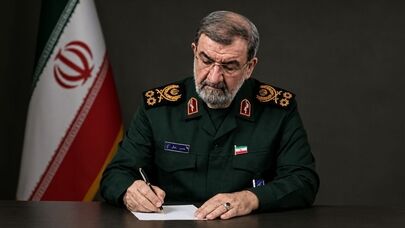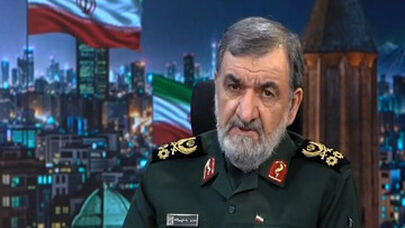
On September 8, Major General Mohsen Rezaei, secretary of the Supreme National Security Council, spoke of establishing a “prohibited zone” extending along the line of the US naval blockade to the Strait of Hormuz. He explained that ships entering the zone in an attempt to transit the strait and subsequently being identified would be placed on Iran’s sanctions list. These remarks laid out the initial framework for a strategy intended to counter the blockade by expanding the range of costs associated with it.
“Besieging the siege” does not mean that Iran simply responds to US pressure by closing a maritime route. Under this model, the entire chain that enables parties to circumvent Iran’s declared restrictions or enforce a naval blockade becomes part of the confrontation. The vessel’s owner, other ships belonging to the same company, and entities involved in transporting or insuring cargo along disputed routes could face sanctions or punitive measures.
In other words, Iran’s message is directed not only at a ship’s captain, but also at the company that decides which route its vessel will take, the insurer that accepts the risks of the voyage, and the network that makes the shipment possible. Within this framework, action against a violating vessel and sanctions targeting the network associated with it are complementary tools: one imposes operational costs, while the other seeks to make repeated violations more costly for the company and its affiliated fleet.
IRGC Statement: From Warning to Action on the Ground
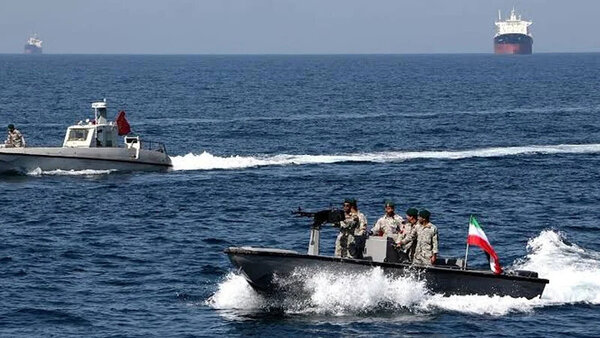
The IRGC Navy’s October 9 statement should be read within this same framework. The IRGC said the NV Sunshine, a liquefied petroleum gas carrier owned by NatWit, was targeted south of the Strait of Hormuz while attempting to transit a route Iran considers unauthorized, causing a fire in its engine room and propulsion system. This is the IRGC’s official account of the incident, and its details should be distinguished from independently verified maritime reports.
The more consequential part of the statement was its warning about what comes next. The IRGC said action against violating vessels would no longer be confined to the Strait of Hormuz and that ships using unauthorized routes would be pursued throughout the region. It also spoke of sanctioning companies that, according to the IRGC, operate within the framework set by the US, and announced punitive measures against vessels belonging to companies found to be in violation.
The key to understanding this message lies in the expanded scope of the threat. Previously, the principal risk was defined in terms of transiting the strait. The IRGC is now saying that the consequences of a violation could continue even after a vessel has left the strait’s geographical limits. In practice, this declaration seeks to turn alternative routes from a relatively low-cost solution into options carrying security, commercial and insurance risks.
From a strategic perspective, the IRGC’s statement indicates that Tehran intends to tighten enforcement of its declared rules and move beyond political warnings toward action on the ground, linking direct enforcement to pressure on the networks that support maritime transit.
Why Did the Oil Market Not Trust Trump’s Remarks?
The consequences of this situation are not limited to the number of vessels passing through the strait. In addition to oil volumes, energy markets respond to the continuity of supply, route security, insurance costs, tanker freight rates and the likelihood of further disruption in the coming days. As a result, even if some cargoes are transported along alternative routes, higher risks and shipping costs can keep final energy prices elevated.
In Thursday’s trading on October 8, Brent crude rose 4.1% to $104.28 a barrel, while US crude gained 3.6% to $91.49 a barrel. Donald Trump’s remarks that he had no plans to attack Iran before the US midterm elections eased some market concerns. However, after a brief pause, Brent resumed its upward trajectory and moved above $104 a barrel. Trump’s message therefore did not eliminate the underlying risks to supply and transportation.
Trump has also claimed that 22 million barrels of oil passed through the Strait of Hormuz in a single night. This remains a claim made by the US president, and the market continued its upward trajectory rather than accepting it as sufficient reassurance. Under current conditions, even if a large volume of oil is transported at a particular moment, that alone cannot demonstrate that exports will continue at the same volume, cost and level of security in the days ahead.
Battle Over Cost and Continuity
“Besieging the siege” is an attempt to change the other side’s calculations. The US seeks to exert pressure by restricting Iran’s access to maritime trade; Iran, in turn, is trying to demonstrate that implementing this policy will not come without costs for shipping and the global energy market, and consequently for the world economy.
The IRGC’s statement carries two messages within this framework. First, routes used for maritime transit are, in Iran’s view, subject to the rules declared by Tehran. Second, companies and vessels that violate those rules will face consequences extending beyond the Strait of Hormuz.
Naturally, the strategy’s ultimate effectiveness will depend on the ability to enforce it consistently, the responses of shipping companies and insurers, and diplomatic developments.
The central question, therefore, is not simply how much oil passes through Hormuz. It is how much it costs to transit the strait, under what conditions transit is possible, and with what degree of certainty. In this equation, the IRGC’s latest statement should be viewed not as an isolated action, but as an operational link in the “besieging the siege” strategy, which seeks to turn maritime pressure from a restriction imposed on Iran into a costly challenge for the entire chain of energy transportation and transit.