Iran’s tourism industry has experienced two security shocks in less than a year: first, the 12-day war from June 13 to July 24, 2025, and then a second round of military hostilities beginning on February 28, 2026, coinciding with the start of the Nowruz travel season. The result was not a complete halt in travel, but rather a shift in destination choices, modes of transportation and types of accommodation.
During these developments, regional travel and tourist movements across the country were affected. Disruptions to transportation and security concerns directly affected hotel and tour bookings. At the same time, destinations with better road access, natural attractions and opportunities for family travel were able to absorb part of the displaced demand.
One important point about these figures is that accommodation occupancy rates are not merely numbers. The indicator can provide a picture of traveler behavior, sensitivity to security, household purchasing power, access to road and air routes, destination appeal and accommodation capacity. Changes in this indicator can therefore also be seen as evidence of changing behavior in the travel market.
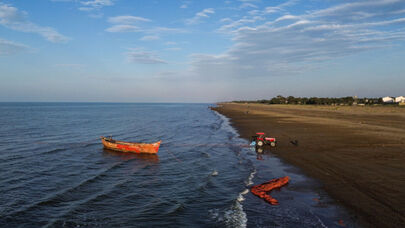
A review of the figures for September shows that northern provinces were among the destinations with higher demand. Ardabil recorded 89 percent occupancy, Mazandaran 88 percent and Gilan 85 percent, making them the three most notable figures recorded. In this context, the advantage of road networks and the diversity of destinations is particularly important, because when flights are disrupted, the possibility of traveling by road can alter families’ decisions.
This situation is not limited to September. During the Nowruz holidays, around 29.7 million overnight stays were recorded at official accommodation facilities. At the same time, some travelers chose to stay with family and friends during the wartime conditions, indicating that official accommodation figures do not capture all aspects of traveler movement and lodging.
Among northern destinations, Mazandaran offers a different picture of sustained demand. From the beginning of June through the end of September 2026, more than 34 million overnight stays were recorded at accommodation facilities across the province, with more than 90 percent of its official accommodation capacity filled during the period. These figures show Mazandaran’s role as more than simply a recreational destination and highlight its position in domestic tourism.
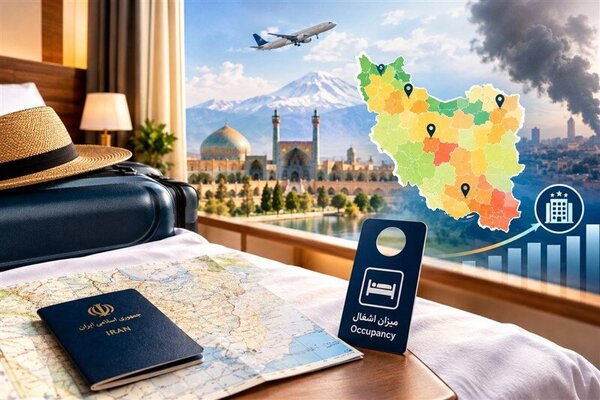
A geographic comparison also points to an uneven distribution of demand. On the accommodation map, provinces have been divided into four levels: above 80 percent, 60 to 80 percent, 40 to 60 percent and below 40 percent. As a result, not all destinations across the country have benefited equally from changes in traveler behavior, and the gap between some provinces and desirable occupancy levels remains significant.
The travel calendar is also a decisive factor. February 2026 and the Nowruz holidays in March 2026 marked the peak of the Nowruz travel season, while June and July 2025 were the peak summer travel period. During both periods, any security or transportation disruption can quickly affect tourists’ decisions, accommodation bookings and choice of travel routes. As a result, security has become one of the important variables shaping decisions in the travel market.
At the same time, higher occupancy does not necessarily mean uniform growth across all segments of the tourism industry. Length of stay, transportation costs, service prices, type of accommodation and the share of travelers staying with relatives all affect the overall picture of the market. A traveler may maintain the trip but choose a closer destination, travel by road or opt for less expensive accommodation. Under such circumstances, the form of travel changes, but travel itself does not disappear.
This change in behavior carries a clear message for policymakers and tourism operators: destinations that simultaneously offer security, road access, diverse accommodation options and natural attractions have greater potential to maintain demand during periods of crisis. The experience of recent months has shown that the geography of travel in Iran can be rapidly reshaped in response to security developments.
Ultimately, the picture emerging from Iran’s accommodation market is not that of an industry that has come to a halt in the face of crisis, but rather of a market that has adapted to new conditions. The destination changes, the route changes and the type of accommodation changes, but demand for travel remains. In this context, northern provinces and destinations with good road access have become some of the most important hubs sustaining domestic tourism.