
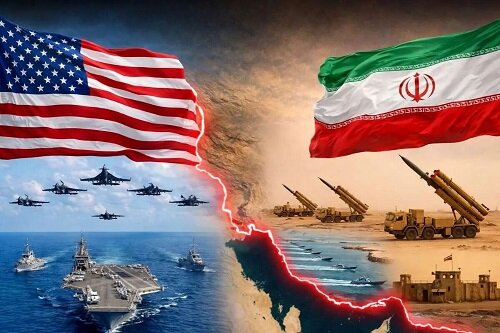
At the start of September, "Black September" was discussed as a scenario for US markets. Developments over the past 48 hours suggest that the term is no longer merely a theoretical warning. New US attacks on Iran, Tehran's broad response against US positions in the region, and Trump's renewed threat to escalate the attacks have put three vital markets under pressure simultaneously: oil, debt and equities. Brent crude, which had been around $90 before the latest round of attacks, climbed more than $4 on Tuesday and reached about $95.50 on Wednesday morning, while US crude also moved above $91.
But the significance of last night's developments extends beyond the battlefield. Markets are now pricing in a fundamental question: Can a US attack contain the crisis, or will it instead become a factor that prolongs the war, raises the risk around the Strait of Hormuz and intensifies inflationary pressures?
The market's initial response to last night's developments was by no means favorable to Washington. As oil surged, the yield on 10-year US Treasury notes rose to around 4.8%, its highest range since early 2025. The 30-year Treasury yield also remained around 5.3%. On the same day, the Dow Jones fell about 0.8%, the S&P 500 about 0.7% and the Nasdaq about 1%. In Asia, the sell-off in bonds and equities continued, putting major regional indexes under pressure.
This is the chain that fully emerged yesterday, on the first day of September: war makes energy more expensive; higher energy prices fuel inflation; inflation reduces the likelihood of interest-rate cuts and even increases the possibility of hikes; higher rates reduce the value of existing bonds and raise the cost of financing for governments and companies; and, ultimately, pressure moves from the bond market to equities and the real economy.
More importantly, the market is no longer pricing in merely a "US attack on Iran"; it is also factoring in the possibility of a prolonged conflict. Iran's warning of further restrictions on traffic through the Strait of Hormuz, coupled with the reciprocal attacks, means increased supply risk for the oil market. That risk is transmitted directly to oil prices, insurance, transportation and, ultimately, production costs across the global economy.
Under these circumstances, Trump's statements also take on an economic significance. On the one hand, he has warned Iran that it will face even heavier attacks if it responds to US strikes, even speaking of a "bigger attack" that has yet to be carried out. On the other hand, in a separate message, he said he was not seeking to bring Iran to the negotiating table and then asked: "When are the people of Iran going to rise up?"
Taken together, these two positions expose an important paradox. Trump wants to demonstrate US military power, but at the same time does not want an Iranian response to push the war into a cycle that increases the costs for the US and the global economy. The threat of a heavier attack could in fact be an attempt to deter another Iranian response, because each new round of attacks and retaliation raises the risks to energy supplies and inflation.
But Trump's second statement is even more significant. Calling on the Iranian people to "rise up and fight" shows that Washington still hopes external pressure can be reinforced by internal pressure. This amounts to an acknowledgment of the limitations of military tools and, at the very least, indicates that the US is not relying solely on bombing and military pressure, but is also looking to an internal component to alter Tehran's calculations. Notably, at the same time, the US Treasury secretary has spoken of sanctions and economic pressure as tools for putting Tehran under pressure.
This is where "Black September" can take on a deeper meaning. The war has failed to produce a rapid outcome on the battlefield, but it has instead pushed oil above $95, lifted Treasury yields to around 4.8% and driven the cost of capital higher, shifting a significant portion of the war's costs from Tehran to Washington and the global economy.
For Trump, this is not merely an economic issue; it is a political one. The American voter does not see the yield on 10-year Treasuries, but does see gasoline prices, mortgage costs, the prices of goods, credit card rates and the performance of the stock market. If oil remains elevated while the bond and stock markets remain under pressure, the war will gradually shift from a foreign-policy issue to something that affects the daily lives of Americans.
From this perspective, although Black September is not yet a certainty, important early signs are already appearing simultaneously: rising oil prices, pressure on bonds, higher yields, falling stocks and growing concerns over inflation. Reuters has also described global markets as facing intensified bond selling amid inflation and fiscal concerns, alongside higher oil prices and geopolitical tensions.
This is where the political calendar becomes important. If this trend continues in the coming weeks, September could become the month when the economic costs of the war become more tangible for Americans; and if September turns markets black, November could be when Trump is forced to pay the political price.
Under such a scenario, the central contradiction of the US war with Iran becomes even clearer: Washington turns to military power to reduce the geopolitical cost of the war, but that same military power can increase the economic cost of the conflict for the US by raising energy risks, inflation and the cost of capital.
"Black September" takes shape precisely here: where the war is no longer being fought only in the skies over Iran and around US military bases, but has moved onto oil-price screens, the bond market, Wall Street and, ultimately, the American voter's shopping basket.
Perhaps "Black September" will take on an entirely different meaning for Trump from this point forward. A president who is looking to an uprising by Iranians against their government could ultimately face a political uprising by Americans against him. If the war drives up oil and inflation, rattles markets and raises the cost of living for Americans, the question Trump is asking the Iranian people today could be repeated against him by American voters in November: "When are the American people going to rise up?" The answer may come at the ballot box.
NOURNEWS