
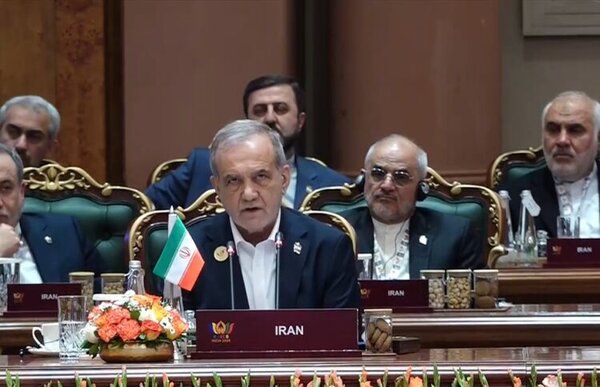
At the closed-door meeting of BRICS leaders on Saturday, Pezeshkian emphasized that the credibility of any governance system rests on its ability to uphold the rights of all nations, whether large or small, and rejected the use of financial and technological systems as instruments of pressure by certain powers.
Stating that "inclusive global governance and strengthening of multilateralism" are of twofold importance today, he emphasized that the legitimacy of the multilateral system would be at risk if it could not protect human lives and national sovereignty against war, genocide, and aggression.
He said inclusive global governance means equal respect for national sovereignty and international law; reforming global governance institutions; turning multilateralism into practical economic cooperation; and stronger opposition to unilateral sanctions.
If the UN Charter fails to protect nations against the illegal use of force, and if international rules are binding for some while remaining open to interpretation for others, one cannot speak of genuine multilateralism, Pezeshkian warned, citing the plight of civilians in Gaza and Lebanon.
He explained it further, saying Iran had experienced the double standard firsthand, in the face of the US-Israeli-imposed war, as the two aggressors martyred the Leader of the Islamic Revolution and 168 innocent children at a school in Minab, as well as sportsmen in Lamerd stadium, which demonstrated how the unilateralism, warmongering, and brutality were compounded by the UN's inaction.
The Iranian president called for reforms to the UN Security Council and international financial institutions to better reflect the changing realities of the world and the role of countries in the Global South.
Stating that the demand for reform of international mechanisms must not be limited to statements, he underlined that transforming multilateralism from a slogan into action requires expanding trade in national currencies, strengthening independent payment mechanisms, and bolstering the role of institutions such as the New Development Bank.
He also called for serious, practical action against unilateral sanctions-which, in practice, target not only governments but also ordinary people, patients, children, and the development trajectories of nations.
Pezeshkian cited the joint US-Israeli aggression against Iran as an example of the shortcomings of the existing international system in compromising security, saying that sustainable security can no longer be defined as security for some at the expense of insecurity for others.
Stressing that BRICS members must stand firmly against the normalization of attacks on civilian and critical infrastructure, he said sustainable security is achieved when national sovereignty is respected, and that no country can use its territory to threaten or attack another.
Peaceful nuclear facilities should be protected from attack or threats of attack as well, as endangering such facilities poses a threat to international peace and security, he argued.
Pezeshkian also highlighted the Palestinian issue, describing it as another test of the credibility of global governance, and emphasizing that Palestinians, like other nations, have the right to self-determination and to live in security.
He urged BRICS to play a more active role in ending the occupation and ensuring the legitimate rights of the Palestinian people.
During his speech, Pezeshkian also outlined Iran's three priority areas for its cooperation within BRICS, saying stronger political coordination among the bloc members in defense of the UN Charter and national sovereignty; expanded economic and financial cooperation independent of monopolistic instruments; and deeper cooperation in science, technology, energy and food security.
Stating that the world today needs cooperation more than ever, yet sustainable cooperation is impossible without justice, he insisted that multilateralism holds meaning only when all are equal before the law, and global governance gains legitimacy only when the voices of developing nations are heard.
In closing, Pezeshkian, while emphasizing adherence to BRICS' fundamental principles and objectives, said the grouping would succeed in pursuing its established goals-particularly the creation of a justice-oriented international order-if it could also overcome certain internal challenges, adding that Iran stands ready to cooperate within the BRICS framework to realize these goals.
IRNA