
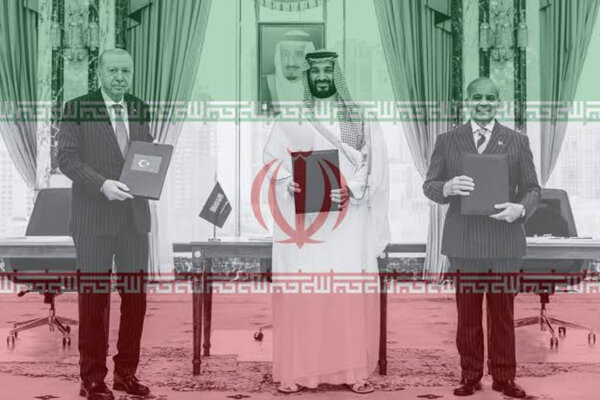
Nournews: Trump's ambitious illusions of dominating the world's geopolitical regions and energy resources have plunged West Asia into a cycle of recurring crises. Yet on the ground, realities point to the decline of America's security hegemony and the emergence of indigenous capabilities to redefine the region's strategic equations. It is against this backdrop that Russian Foreign Minister Sergey Lavrov's remarks on the possibility of Iran joining the "Mecca Agreement" between Pakistan, Türkiye and Saudi Arabia take on significance far beyond that of a mere diplomatic proposal.
Lavrov said Moscow considers Iran's possible accession to the mechanism "a step in the right direction," adding that the potential participation of Algeria could also have a positive impact. In his view, reaching agreement on the terms of Iran's participation could be the most practical step toward an arrangement that Russia has already envisioned as part of its broader approach to regional security structures. The significance of this position becomes even clearer when viewed in light of Russia's growing convergence with Iran and the Arab states, as well as the membership of some of these countries in BRICS.
The Ramadan War: The Moment America's Security Umbrella Collapsed
Lavrov's comments on the changing attitude of regional countries toward the American security umbrella are less a theoretical assessment than a reflection of the realities exposed by the Ramadan War. For years, the United States had made the provision of security the cornerstone of its influence in West Asia. Yet on the battlefield, it demonstrated that it was unable even to guarantee the security of its own bases and forces. The episode involving the USS Abraham Lincoln was only one manifestation of this reality.
The Ramadan War also once again exposed Washington's overriding priority: ensuring the security of the Israeli regime, while other regional actors occupy a secondary position in America's strategic calculations. From this perspective, the battlefield experience delivered a clear message to the region: lasting security cannot be achieved by relying on extra-regional powers, but rather through resilience, regional cooperation and an end to foreign intervention. Iran's initiative in the Strait of Hormuz was another powerful example of indigenous capabilities reshaping the region's security equations.
Signs of this changing outlook can be seen in the security agreement between Pakistan, Türkiye and Saudi Arabia, as well as Qatar's remarks about the inadequacy of relying on American security guarantees. Together, these developments point to the gradual emergence of a new security perception in West Asia.
Iran: From the Hormuz Peace Initiative to an Indigenous Security Architecture
Lavrov's proposal for Iran to participate in the Mecca Agreement should not be interpreted as a call for Iran to alter the nature of its policies or to place Tehran within the structural objectives of the pact. Rather, it can be viewed as consistent with an idea Iran has emphasized for years: regional security must be built by the countries of the region themselves.
The "Hormuz Peace Initiative" and Iran's more than four decades of hosting the Islamic Unity Conference are examples of this approach-one that views security not as a product of foreign powers' presence, but as the outcome of dialogue, convergence and responsibility among indigenous regional actors. This outlook remains a consistent feature of Iran's regional policy. President Masoud Pezeshkian's positions at the Shanghai Cooperation Organization summit, along with remarks by Mohammad Baqer Ghalibaf, Iran's special representative for China, about Tehran's welcome for China's proposal to establish a new regional security architecture, underscore the need for the region's future to be shaped by the countries of the region themselves.
West Asia: A Crucible for the Future Global Order
Lavrov's remarks cannot be assessed solely through the lens of regional security. At a broader level, they form part of the contest over the shape of the emerging global order. China and Russia's positions at the Shanghai summit in favor of strengthening a multilateral order, along with Chinese President Xi Jinping's emphasis in talks with Egyptian President Abdel Fattah el-Sisi on the need to free the region from America's security tutelage, suggest that the idea of allowing the people and governments of West Asia to determine their own destiny is gradually becoming an important discourse within the emerging global order.
Given its vast energy resources and exceptional geopolitical position, West Asia has always played a decisive role in global and civilizational affairs. Many of the world's major conflicts have also been imposed on the region. As a result, no new global order can take shape without resolving the question of West Asia's place within it-particularly at a time when the confrontation between Western unilateralism and a multilateral order is playing out so prominently in this very geography.
Independence: The Prerequisite for Moving Beyond Imposed Security
Building an indigenous security architecture first and foremost requires the region's countries to achieve practical independence in the face of American pressure and coercion. The removal of foreign military bases, a unified response to Israeli aggression, support for Iran's central role in safeguarding the Persian Gulf, the expulsion of extra-regional forces, and stronger ties among the actors of the emerging order through groupings such as BRICS and the Shanghai Cooperation Organization could help pave the way for this transformation.
The first step, in this regard, is to end overt and covert support for American aggression against Iran. Such a move could mark the beginning of confidence-building among regional countries and lay the groundwork for strategic unity aimed at localizing security.
West Asia is moving beyond an era in which others defined its security. The region's future will be shaped only when its true stakeholders decide for themselves on their security, stability and destiny.
NOURNEWS