
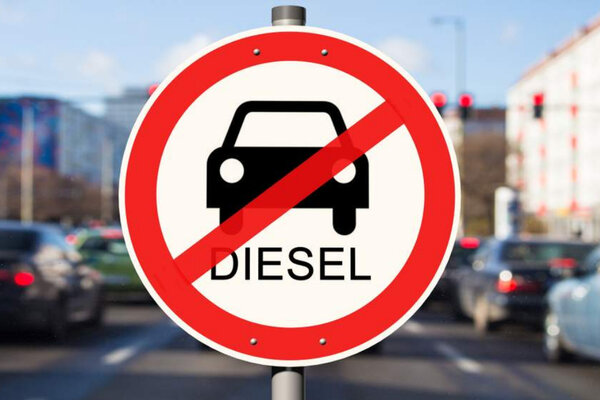
Europe's diesel market has entered a phase that could prove to be one of the clearest signs of the energy crisis spreading from the crude oil market to the real economy. Diesel prices in Europe have reached a record €2.185 per liter, equivalent to about $9.57 per gallon. This is not merely a price record, but a warning that new pressure is building across the energy, transportation and global trade chains. Reuters has also reported that diesel cargoes in Europe have now become more expensive than jet fuel, while European Union diesel inventories have fallen to levels close to their historic lows in 2022.
But understanding this price surge requires taking the war and the Strait of Hormuz into account. The Hormuz crisis is putting pressure on global markets at a time when a significant share of the Middle East's energy trade depends on this waterway. Disruptions to the passage of oil and petroleum products, higher insurance and maritime transportation costs, and more difficult access for refineries to feedstock and export markets do not affect crude oil prices alone; they can expose markets for products such as diesel to a far more direct shock.
The significance of this lies in the fact that crude oil and diesel markets do not necessarily behave in the same way. There may be claims of a crude oil surplus in one part of the market while the diesel market is simultaneously facing a supply shortage. Diesel is a refined product, and refinery capacity, feedstock composition, the condition of refineries, trade routes and access to refined products determine how much diesel is actually available to the market. Therefore, the narrative of an "oil surplus" cannot, on its own, explain the condition of the energy market.
What is happening in Europe today is the result of the interaction of several shocks. The war and disruptions to Middle Eastern energy routes on one side, restrictions on exports and damage to Russia's refining capacity on the other, and Europe's reduced access to some traditional sources of diesel have increased pressure on the refined-products market. At the same time, Europe's diesel imports have also declined significantly. According to Reuters, European diesel imports fell from about 1.97 million barrels per day in January to 1.56 million barrels per day in July.
These figures become more significant when we consider that, unlike crude oil, diesel is directly tied to economic activity. Trucks, agricultural machinery, industrial equipment and a large part of the road-transport fleet depend on diesel. Therefore, a surge in diesel prices is not merely an event in the energy market; it is a potential shock to transportation costs and, subsequently, to the prices of goods.
If diesel becomes more expensive, the cost of transporting raw materials and goods increases. Truck operators pay more for every mile travelled, farmers pay more for fuel for their machinery, and producers face higher costs to get their products to market. These higher costs can ultimately be passed on to consumers. For this reason, a diesel crisis can be one of the fastest channels through which an energy crisis translates into inflation.
From this perspective, what is happening in Europe's diesel market should be viewed as part of a broader economic resilience war. In such a war, the country that produces more oil is not necessarily the winner; the more successful country is the one that can keep its energy, refining, transportation and supply chains resilient in the face of shocks.
The Strait of Hormuz becomes important at precisely this point. Hormuz is not merely a route through which barrels of oil pass; it is part of a network that connects oil and petroleum products to refineries, refineries to fuel, and fuel to trucks, ships and factories. The longer the disruption to this chain continues, the shorter the distance becomes between a geopolitical crisis and people's economic lives.
For this reason, the record diesel price should not be viewed merely as a number in the energy market. It could be a warning signal for the global economy: the war has moved beyond the oil market and reached the fuel that keeps transportation and trade moving.
An oil crisis may appear in economic headlines; but a diesel crisis will be felt in the wheels of trucks, the prices of goods, the cost of living and rising inflation.
NOURNEWS