
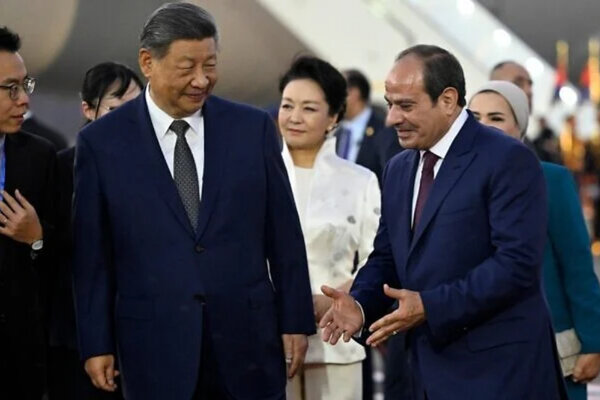
Nournews: Trump's vision of reshaping the world around American will-through warmongering, pressure, and the disruption of international rules-has increasingly drifted away from the realities of the emerging global order. While Washington continues to portray itself as the central axis of international developments, Beijing is steadily, gradually, and strategically expanding its global influence and role-a process that has now reached one of the Arab world's most important countries: Egypt.
Chinese President Xi Jinping's landmark visit to Cairo, his first in a decade, cannot be viewed merely as a bilateral meeting with Egyptian President Abdel Fattah el-Sisi. Rather, it should be assessed within a broader framework and as part of the transformations shaping the emerging global order-an order in which rising powers are increasingly seeking to define their relations on the basis of national and strategic interests.
China-Egypt relations are rooted in decades of interaction and convergence between two ancient civilizations. The Comprehensive Strategic Partnership agreement signed by the two countries in 2014 marked a turning point in efforts to deepen those ties. Today, Beijing and Cairo appear to be seeking to overcome some of the shortcomings of the past and open a new chapter in strategic cooperation.
Beijing and Cairo: From Trade to Technology and Security
In an article published in Egyptian state media ahead of his visit, Xi described relations between the two countries as being at their best point in history. He stressed the need for a more comprehensive strategic partnership, high-quality cooperation under the Belt and Road Initiative, expanded cultural exchanges, and deeper Chinese cooperation with the Arab world and Africa.
For his part, el-Sisi, outlining his vision for the future of bilateral relations, identified electric vehicles, energy-storage batteries, renewable energy, electronic equipment, shipbuilding, and desalination technologies as priority areas for cooperation. He also highlighted technology transfers in telecommunications, artificial intelligence, and space sciences.
These priorities show that the economy remains the main pillar of relations between Beijing and Cairo, with bilateral trade estimated at around $10 billion. Yet the relationship is no longer confined to trade and investment.
The joint "Eagles of Civilization" air exercise, involving China's J-16 fighter jets, Egypt's Rafale aircraft, and other military equipment, points to cooperation extending into the security and defense spheres. At the same time, the two countries' shared positions on developments in West Asia-including the need to end the war, prioritize diplomacy, and uphold the rights of the Palestinian people-reflect a gradual expansion of the scope of China-Egypt relations.
Egypt: America's Ally Yesterday, an Independent Player Today
The significance of this shift becomes even clearer when Egypt's traditional place in US strategic calculations is taken into account. Since the Camp David Accords, Cairo has defined a major part of its regional policy within the framework of its relationship with Washington. Today, however, there are clear signs that Egypt is moving toward a more balanced and independent foreign policy.
Its membership in BRICS, expanding relations with Russia and Iran, mediation efforts in several regional disputes, and emphasis on expanding China's presence in Africa are all part of this shift. Even in the Palestinian crisis, Cairo has at times sought to place its own national considerations and interests ahead of the demands of external powers.
Meanwhile, the UAE's economic moves against Egyptian interests and Israel's dissatisfaction with some of Cairo's policies have added further complexity to the equation. Egypt has gradually come to recognize that relying solely on one foreign power does not necessarily guarantee national security or national interests, and that the new era requires a diversification of strategic partnerships.
Iran's Strength: Accelerating a Post-American Order
Behind these developments, another important reality is also taking shape: the global order is moving beyond Western monopoly and unilateralism, and Iran's experience of resisting multilayered US pressure has become one of the factors influencing the calculations of many countries.
Drawing on its defense capabilities, diplomatic resilience, economic and social endurance, and its strategic position in the Strait of Hormuz, Iran has demonstrated that maximum pressure does not necessarily lead to surrender. That experience, alongside other developments, has challenged the assumption that the United States can impose its will on every actor.
From defense and security agreements involving Pakistan, Turkey, and Saudi Arabia, to the deepening ties between Russia and Iran and countries across the region-and now Xi Jinping's visit to Cairo-signs of a gradual realignment in global and regional power relations are becoming increasingly visible.
The emerging world is not necessarily an anti-American one. Rather, it is increasingly a world in which countries are seeking to replace "dependence" with "balance" and "following" with "strategic autonomy." Beijing's outreach to Cairo should be viewed through this broader lens-a larger picture in which, quietly and without fanfare, the pieces of a new global order are gradually falling into place.
NOURNEWS