
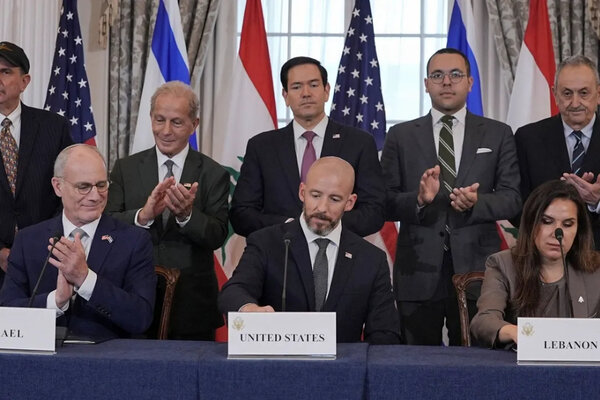
Nournews: After several days of purported negotiations in the United States, U.S. Secretary of State Marco Rubio claimed that Tel Aviv and Beirut had reached a framework for an agreement. The architects of this arrangement-from Lebanon's pro-Western government to Israel and the United States-argue that its implementation will restore security to Lebanon and the broader region. However, available evidence, particularly the conduct of the United States and Israel in Gaza, raises serious questions about these claims.
Moreover, the substance of the proposed agreement appears less concerned with promoting security than with placing Lebanon on a path toward internal conflict while consolidating Israel's occupation. At the same time, the Lebanese people, along with nationalist and resistance movements, continue to stress the need to resist what they describe as an American-Israeli scheme.
A Security Initiative or a Blueprint for Civil War?
The United States claims that it seeks to strengthen the Lebanese Armed Forces and enhance Lebanon's security by allocating $30 million in assistance. Compared with the tens of billions of dollars in military aid Washington has provided to Israel, however, this amount appears less like meaningful support than a bitter irony.
Given the Lebanese Army's structural limitations, any genuine effort to strengthen it would require billions of dollars over several years for training, modernization, and rebuilding its operational capabilities. Consequently, the U.S. assistance package-even if supplemented by contributions from certain Arab and Western countries-lacks practical credibility and appears designed to pursue objectives beyond Lebanon's security.
Even Israeli media have acknowledged that one of the principal aims of the agreement is to push the Lebanese government into confrontation with Hezbollah. For Israel, internal conflict in Lebanon represents a favorable scenario, and by deepening polarization between supporters of the government and the resistance, it seeks to facilitate precisely such an outcome.
Lebanon's own history demonstrates where such a strategy can lead. The country's previous civil war ultimately opened the way for Israeli forces to advance toward Beirut. Critics therefore view the current approach as part of the broader "New Middle East" project associated with the Zionist vision extending "from the Nile to the Euphrates."
Consolidating Occupation Under the Cover of "Pilot Zones"
Although Washington maintains that the agreement will restore Lebanon's full sovereignty, its proposal to establish "pilot zones" and gradually transfer certain areas to the Lebanese Army tells a different story. Since these transfers would occur only according to Israeli planning and approval, while other areas remain under Israeli occupation, the arrangement effectively institutionalizes occupation as part of the proposed security framework.
In other words, having failed to achieve its objectives on the battlefield, Israel now appears to be using the agreement to legitimize its control over strategically important areas of southern Lebanon. Critics argue that this mirrors its approach in Gaza, where territory under Israeli control has continued to expand.
Notably, the agreement provides no clear timetable for the withdrawal of Israeli forces. Instead, conditions such as Hezbollah's complete disarmament and Israel's absolute satisfaction that no security threat remains are presented as prerequisites for any future withdrawal. Experience suggests that such verification requirements could become open-ended, effectively allowing the occupation to continue indefinitely.
This concern is reinforced by provisions reportedly preserving the Israeli military's freedom of action throughout the designated security zone against any perceived threat. In practice, this would leave Israel's military operations largely unrestricted.
Meanwhile, rather than assigning the Lebanese Army responsibility for defending national sovereignty and repelling aggression, the agreement defines one of its principal tasks as disarming Hezbollah, effectively placing it in a role that complements Israeli security objectives.
Despite this, Lebanon's pro-Western leadership presents the agreement as paving the way for displaced residents to return to southern Lebanon. Yet Israeli officials have publicly stated that many Lebanese residents will not be permitted to return and have spoken of incorporating these areas into territory under Israeli control.
Hezbollah: A Resistance Movement with Legal Status and Popular Legitimacy
A central feature of the proposed agreement is that issues such as restoring Lebanon's full sovereignty, strengthening the national army, and rebuilding the country are postponed to an undefined future. Its only immediate priority is the disarmament of Hezbollah-or, as critics describe it, rendering Lebanon defenseless.
This approach also raises legal concerns. Under Lebanon's existing legal and political framework, Hezbollah enjoys both legal recognition and substantial popular legitimacy. The country's defense doctrine has long rested on three pillars: the army, the people, and the weapons of the resistance. Consequently, opponents argue that any attempt to disarm Hezbollah would conflict with existing law.
Furthermore, any change to this legal framework would require broad national consensus in Parliament-an outcome that appears unlikely given opposition from significant Shiite, Sunni, and Christian political forces.
Hezbollah also continues to enjoy considerable public support. Following reports of the proposed agreement, demonstrations were held in numerous parts of Lebanon, with participants expressing support for the resistance's weapons while protesting what they viewed as a policy of compromise.
Taken together, these factors suggest that negotiations between the Lebanese government and Israel have proceeded without broad legal or national consensus and instead reflect the decisions of a particular political leadership. Critics therefore argue that the agreement lacks both legal validity and practical enforceability.
The Islamabad Agreement: A Framework That Cannot Be Bypassed
By drawing Lebanon's conciliatory government into this proposed agreement, the United States and Israel claim to be promoting Lebanon's security. Critics, however, argue that the initiative represents an unsuccessful attempt to circumvent the Islamabad Agreement.
According to this view, the 14-point agreement between Iran and the United States explicitly addresses Lebanon, its security, and its future as an integral part of the broader understanding. Consequently, they contend that the proposed U.S.-brokered agreement falls outside the accepted legal framework and therefore lacks legitimacy.
From this perspective, neither the United States nor Israel can remove the Lebanon file from the 14-point framework or use separate arrangements to legitimize Israel's military presence. Supporters of this interpretation maintain that the United States remains obligated under the Islamabad Agreement to bring Israel's occupation to an end, and that no parallel initiative can override or diminish that commitment.
Nournews