
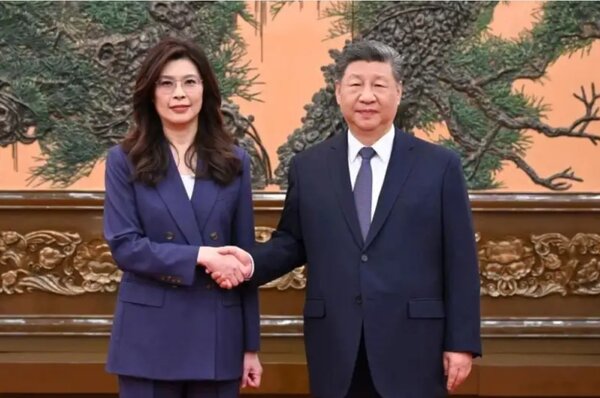
Nournews: In a significant development in East Asia, Chinese President Xi Jinping hosted Taiwanese opposition leader Cheng Li-wen in Beijing, an event regarded as the first meeting of its kind in more than a decade. On the one hand, the event is seen as reflecting the spread of distrust in U.S.-led security arrangements-from Europe and Arab countries to East Asia. On the other hand, it can be interpreted as part of a broader pattern of previously ignored warnings by U.S. war-oriented leaders about the aftershocks of military actions against Iran, affecting other U.S. allies-from South Korea facing North Korea, to Ukraine and Europe confronting Russia, and Taiwan confronting China. This situation is portrayed as the result of an "Israel First" policy and the exposure of what is described as the hollow nature of U.S. military dominance.
Allies: The First Victims of U.S. and Israeli Policies
While the United States has claimed to provide security to its allies and partners-from Europe and Arab states along the Persian Gulf to Taipei, South Korea, and Japan-it is argued that these relationships have involved economic extraction and political-security dominance. According to this view, military escalation policies associated with Donald Trump, framed around an "Israel First" principle, have exposed the fragility of such security commitments and increased dissatisfaction among U.S. allies.
It is further argued that, to satisfy pro-Israeli interests, Trump not only imposed heavy economic, political, and security costs on Americans and their allies, but also redeployed defensive and military systems-previously intended to provide deterrence for allies such as Ukraine, Russia, South Korea, and Japan-to West Asia. This is portrayed as evidence that the security of those countries has been considered less important compared with "Israel First" priorities.
Power That Proved Hollow
U.S. security guarantees, often justified by claims of military superiority in warfare and security-building, have cost U.S. allies billions of dollars annually. In some cases-such as Taiwan-they have also created significant financial burdens on U.S. taxpayers. However, the so-called "Ramadan War" is presented as having exposed the alleged fragility of these claims.
According to this perspective, the war demonstrated that outcomes are not determined solely by military strength but by newer factors such as economic resilience, national unity, asymmetric strategies, and the transformation of potential power into operational capability.
Many observers-including U.S. allies-are described as concluding that reliance on U.S.-led security arrangements is ineffective and costly, prompting a renewed focus on modern security principles as a strategic necessity.
Warnings That Went Unheeded
It is argued that the United States, while engaging in military actions against Iran and the wider West Asian region, ignored repeated warnings about the global consequences of such escalation. From the earliest deployment of U.S. naval forces to the region, concerns were raised that the conflict would have worldwide repercussions.
The conflict is framed as not merely a regional development but one with global consequences-affecting not only West Asia but the broader international system. The economic costs of military escalation are described as only one dimension, with rising security pressures on U.S. allies forming another critical aspect.
The involvement of the United States in military conflict against Iran, despite claims by figures such as Joe Kent that there was no direct threat to the United States, is argued to have strengthened perceptions of the unreliability of U.S. peace-oriented claims. This, in turn, is said to encourage increased military assertiveness by Russia in Ukraine, growing pressure by China on Taiwan, and expanded military demonstrations by North Korea against South Korea and Japan.
The World in Search of a New Order
The "Ramadan War," alongside its economic repercussions, is described as accelerating global momentum toward a new international order. In this envisioned system, Iran is portrayed as playing a decisive role in the Strait of Hormuz, while U.S. militarization is characterized as destabilizing rather than protective.
According to this narrative, the war demonstrated both the decline of what is portrayed as U.S. military dominance and the growing importance of regionally based security systems. It also reinforced calls to contain Israel and the United States, while strengthening opposition to U.S.-centered security frameworks globally.
This situation is reflected, in this analysis, in China's posture toward Taiwan, intensified Russian operations in Ukraine, and heightened military signaling by North Korea toward South Korea-developments linked to U.S. policies in West Asia and seen as accelerating the transition toward a new, regionally oriented global order.
Nournews