
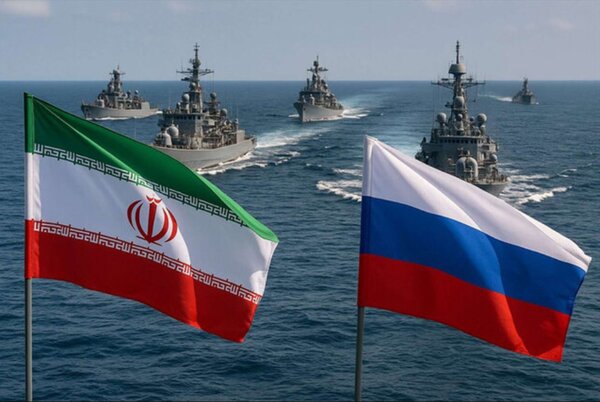
Nournews: The presence of the Russian helicopter carrier Stoyevskiy in the First Naval Zone of the Iranian Army in Bandar Abbas, along with the hosting of a combined naval exercise by the Islamic Republic of Iran, can be analyzed within the framework of Tehran's strategy to consolidate indigenous security in its surrounding waters. The drill, involving surface and aerial units from both countries, has been designed to enhance maritime security in the Sea of Oman and the northern Indian Ocean.
This exercise is taking place after the Islamic Revolutionary Guard Corps Navy conducted an independent drill in the Strait of Hormuz. The simultaneity of these two events presents an image of a multi-layered security architecture-one that is first rooted in domestic capabilities and then expanded toward regional synergy.
The core message of this trend is that regional security is no longer defined by extra-regional fleets, but rather by indigenous capacities and the shared will of coastal actors. This paradigm shift challenges the traditional balance of power based on the direct presence of the United States.
Strategic Convergence Between Tehran and Moscow
The recent naval drill cannot be analyzed in isolation from the broader framework of Tehran-Moscow relations. Cooperation under the 20-year strategic agreement between the two countries encompasses economic, energy, transit, and technological domains. Concurrent with the drill, documents and memoranda of understanding were signed in areas such as standards, oil research, and social cooperation, while the completion of Iran's nuclear power plant capacities is also on the agenda.
Russia's extensive investment in Iran's oil and gas industries and agreements related to the Rasht-Astara corridor indicate that the bilateral relationship is not purely military; rather, a multidimensional convergence is taking shape. The naval drill should be seen as the security arm of this convergence.
At a time when the West is using sanctions, economic pressure, and psychological warfare to create divisions among neighbors, the growing Tehran-Moscow alignment represents resistance to a strategy of regional isolation. This cooperation also carries a deterrent message for actors who view regional security as dependent on foreign forces.
Security as the axis of Regional Convergence
Iran's declared strategy in recent years has emphasized a region-centered order and neighborly engagement. The Hormuz Peace Initiative and active participation in regional mechanisms reflect the belief that security must be provided by regional countries and for regional countries.
West Asia faces threats such as terrorism, foreign interventions, and structural crises. In such an environment, security is a prerequisite for any economic and social convergence. The joint Iran-Russia drill can be seen as a practical example of cooperative security, emphasizing collaboration over competition.
Iran's membership in organizations such as the Shanghai Cooperation Organization and BRICS, as well as the expansion of engagement with the Eurasian Economic Union, demonstrates Tehran's effort to consolidate its position within an emerging network of security and economic arrangements. The recent naval drill fits within this framework.
The Decline of Unilateralism and the Shift in Maritime Balance
Current developments indicate a gradual transition from a unipolar order to a multipolar structure. In this context, the prominent role of mechanisms such as BRICS and the Shanghai Cooperation Organization in security and economic domains reflects a redefinition of the global balance of power.
The simultaneity of the Iran-Russia drill with U.S. naval movements in the region carries a symbolic message: the era of U.S. monopoly over maritime security is coming to an end, and regional actors are capable of redefining the equations by relying on their own capabilities.
In this environment, the concept of deterrence has also evolved. The mere physical presence of extra-regional fleets is no longer decisive; instead, indigenous capabilities, strategic networking, and regional alliances play the primary role. The joint Tehran-Moscow drill can be viewed as part of a process of consolidating an order based on indigenous security, regional cooperation, and multilateralism.
NOURNEWS